
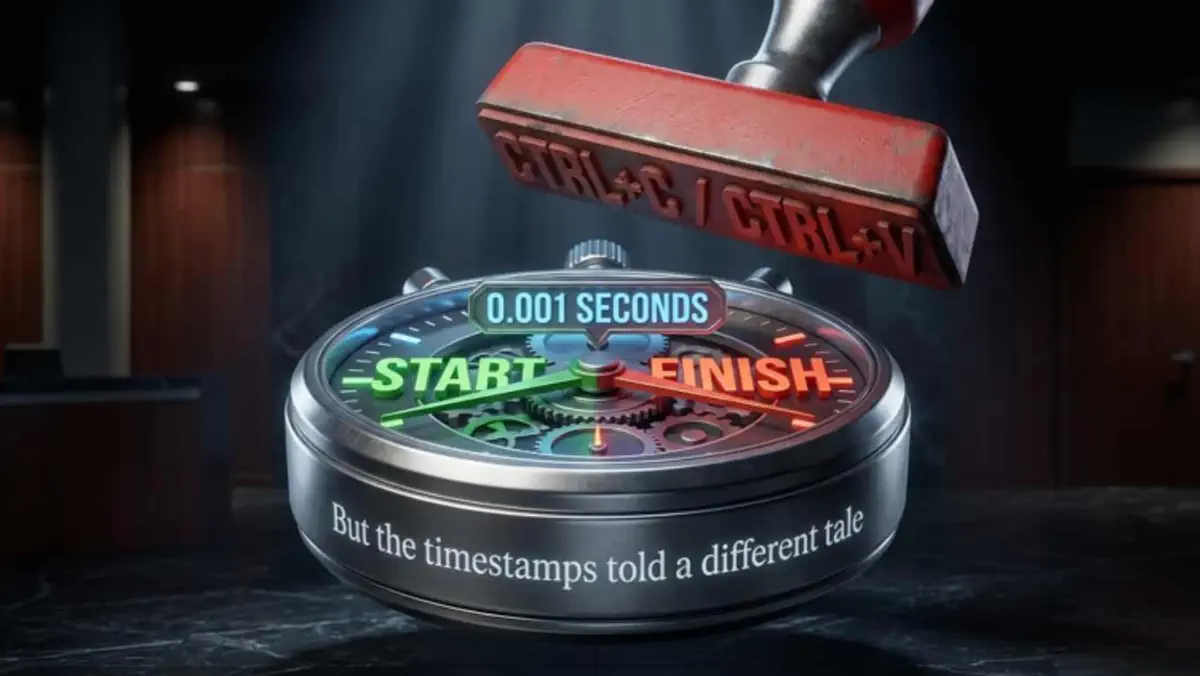
The Detection Arc, Day 1
Yesterday's interlude gave us the specimen.
A colleague notices that the rhythm is off before they can prove why. The work arrives a little too fast, a little too polished, and somehow detached from the person supposedly doing it. The easy things drag. The harder things flourish with suspicious ease. Everyone keeps functioning. Nobody has evidence yet. Still, the room has already begun to register a seam.
That matters because most institutional detection starts too late.
By the time a workplace has timestamps and side-by-side comparisons and policy clauses and a meeting nobody wants to be in, the actual governance work has already failed. The seam was there earlier. It was visible in tempo, in pacing, in the mismatch between where effort should have been and where it appeared to vanish.
Today's question lives there. What does suspicious rhythm look like before accusation is possible?
Reading Artifacts, Missing Routes
That is a harder question than it sounds. Most organizations are trained to read outputs, full stop. Deliverable present or missing. Email sent or unsent. They know how to evaluate the artifact once it lands. They are far less practiced at noticing when the route by which it landed has stopped making human sense.
That is the speed inversion.
A task that should have required visible wrestling appears fully formed and serene. A task that should have taken ten ordinary minutes somehow lingers for days. The hard part looks weightless. The easy part looks heavy. The sequence of strain no longer matches the shape of the work.
Once you start looking for it, this pattern turns up everywhere. A junior team member produces a complex survey instrument faster than anyone expected, yet takes an oddly long time to answer a straightforward client email.
A beautifully structured concept note appears at 10:47 PM, polished to the same smooth register as the one before it and the one before that, yet the next morning's live discussion is hesitant, vague, and oddly unmoored from the document's apparent confidence.
A person who once struggled productively through messy drafts now delivers finished surfaces with almost no visible trail of iteration, while small spontaneous requests suddenly become effortful.
None of these examples prove misconduct. That is exactly the point. The speed inversion is an observational signal. A provocation, if you like. Certainly not a verdict.
Tempo as Evidence
Institutions get into trouble when they skip straight from unease to accusation, or from polished output to false reassurance. Both errors come from the same weakness. They have never learned to treat tempo as evidence.
And tempo is evidence, because real work has a metabolism.
Human effort leaves a certain kind of trail. It bunches, hesitates, loops back, asks awkward questions, reveals partial understanding, improves unevenly. Authentic fluency exists, of course. Some people really are fast. Some are gifted. Some have deep domain familiarity and can move with startling ease. AI assistance now belongs in that same real-world landscape. Sometimes a mismatch reflects overload, uneven skill, hidden constraints, disability, or simply a different way of working. Sometimes it reflects tool use somewhere in the process. Sometimes it reflects both. Speed itself is beside the point. So is AI use by itself. The real question is whether the distribution of speed still makes sense for the kind of work being claimed.
That is where the inversion lives. The signal is "fast in the wrong places." Speed in isolation tells you almost nothing. Speed with a strange centre of gravity tells you where to look.
This distinction matters because a governance framework that punishes velocity will quickly become stupid (and they do, with impressive consistency). Fast is often good. Fast can reflect competence, familiarity, trust in the material, collaborative support, or a well-used tool. The concern begins when velocity detaches from the expected burden of the task and nobody in the room can say how.
- A person who writes code quickly and answers email slowly may simply be a strong coder who dislikes email.
- A person who brainstorms instantly and crawls through data entry may be genuinely creative and administratively bored.
- Someone who shines asynchronously and stumbles synchronously may be introverted, anxious, tired, overloaded, or just bad at meetings.
- A person who uses AI openly for ideation, structure, or first-pass drafting may also be doing perfectly legitimate work.
Any one of these can have ordinary explanations. That is why observational discipline matters. The point is to learn which mismatches deserve a conversation, and to make that conversation broad enough to include the realities of contemporary work, rather than turning every anomaly into an indictment.
The Sunday Specimen, Revisited
The Sunday case study helps here because it gave us a clean example. The complex coded tool came too easily. The basic client email did not. The polished Excel dashboard existed as artifact, then failed as live comprehension the moment someone asked for changes on the spot.
That is what institutions often miss. Detection begins in the body long before it reaches the report.
A manager thinks "something about this pacing does not add up." A colleague notices that the supposed author can describe work in broad terms, but struggles when the discussion moves into its actual logic. A team starts compensating around a mismatch it has not yet named.
This is institutional perception in its earliest form. Untidy. Embarrassingly intuitive. Often dismissed as "just a feeling." Yet in many real workplaces it is the first contact point between surface output and underlying reality.
Four Shapes of the Inversion
The challenge is how to use that signal without becoming either paranoid or naive. For that, it helps to split the speed inversion into its common forms.
- The first is the technical-communicative split. The artifact requiring formal structure, pattern completion, or machine-legible logic arrives rapidly. The human-facing communication around it lags behind. A budget model appears in record time. The email explaining three simple tradeoffs takes forever. The person can generate the product more easily than they can inhabit the reasoning around it.
- The second is the creative-analytical inversion. Ideas arrive instantly, often in polished language, while slower, grounded, procedural work becomes strangely sticky. The concept note sings. The follow-through trudges. This can happen because generative systems are very good at producing plausible surfaces of ideation while leaving the human with the less glamorous labor of sorting, checking, grounding, adapting, and owning what was produced.
- Then there is the synchronous-asynchronous gap. Async work appears smooth, fluent, and complete. Real-time discussion, modification, or collaborative navigation reveals a very different level of grasp. Distance helps the wrapper hold. Presence changes what becomes visible.
- And finally, a subtler fourth: the vanishing revision trail. Work that once moved through visible iterations (messy drafts, partial logic, structural pivots) now arrives fully formed, as if the struggle happened offstage. The artifact looks born, not built.
Taken together, these inversions do not tell you a person is cheating. They tell you where to look next.
Between Surveillance and Denial
The detection problem becomes dangerous the moment institutions forget that rhythm is an invitation to inquiry, rather than a basis for punishment. A workplace that treats every seam as proof will become punitive and brittle. It will reward concealment and penalise eccentricity. It will turn managers into amateur detectives of harmless variation.
A workplace that treats no seam as meaningful will drift the other way. It will keep admiring polished outputs while losing contact with comprehension, ownership, and risk. It will wait for breach instead of building early visibility.
So what sits between surveillance and denial?
The phrase I want for it is generous suspicion.
Suspicion sounds harsh. Generosity sounds soft. Together they do useful work.
Generous suspicion means taking the mismatch seriously enough to ask about it, and openly enough to leave room for the full range of real explanations. Sometimes the issue is overload, uneven skill, hidden constraints, disability, or simply a different way of working. Sometimes it is AI assistance, used well, used badly, or used without enough disclosure. The point is to refuse two temptations at once: the temptation to ignore the seam because proof is missing, and the temptation to treat the seam as proof because you have already decided what it must mean.
That matters because once AI use is treated as unspeakable, every anomaly has to be interpreted indirectly. Workplaces end up reading shadows because they have failed to make the underlying practice discussable.
The Calibration Question
A manager working from generous suspicion does not open with accusation. They open with calibration.
I notice the hard part seemed instant and the easy part took three days. Walk me through how you approached it, including any tools or support you used.
That question does several things at once:
- It names the rhythm without pretending to know the cause. It creates space for explanation.
- It lets competence show itself in narrative form.
- It gives the person room to disclose tool use, workflow differences, hidden blockers, or support needs before the situation hardens into something worse.
Most importantly, it keeps detection inside the social contract. That is where it belongs.
Because the real governance failure is that workplaces still rely on a strange fiction in which AI use remains invisible until it becomes scandalous. The result is a room full of people trying to interpret anomalies with almost no agreed language for discussing assisted work in ordinary professional terms.
That silence distorts rhythm.
When disclosure is culturally unavailable, the only signals left are indirect ones. Strange speed. Strange polish. Strange gaps between artifact and agency. Institutions find themselves reading shadows because they have failed to make the underlying practice speakable.
The better question, then, is how to make workflow visible enough that legitimate use, weak use, and substitution do not all collapse into the same suspicious blur.
From Detection to Craft
That shift matters for another reason.
Workplaces get smarter when AI use becomes discussable early enough to support both governance and craft. The goal is to surface method alongside concealment. How did this result get produced? Which parts came from the tool, which from the worker, and which still required judgment, checking, restructuring, or domain knowledge? Those conversations make it easier to distinguish augmentation from disappearance. They also make it more likely that strong practices spread across the team instead of remaining hidden behind private workflows, uneven access, or defensiveness.
Early visibility, in other words, lets good practice proliferate. That is governance doing something more interesting than catching people.
More conversations about how strong outputs are actually produced would probably do more for workplace quality than a great deal of anxious prohibition. Which prompts helped. Which iterations improved the result. Where the tool saved time. Where it introduced nonsense. Where human judgment still had to do the hard part. Those are useful professional conversations. They turn tool use from private trick into shared craft.
That, in turn, makes honesty easier.
The less tool use is treated as inherently discrediting, the less pressure there is to conceal it. And once concealment drops, institutions can govern the issues that actually matter: disclosure, verification, data handling, authorship, access equity, skill development, dependency risk, and where human judgment still has to remain firmly on the hook.
Rhythm, Revisited
So the Monday question is not "how do we catch them?"
It is "how do we learn to see the seam early enough for a conversation?" And then, just as importantly, "how do we make that conversation useful?"
One version of that conversation is diagnostic. Another is developmental. A manager may be trying to figure out whether the person understands their own deliverable. A team may also be trying to learn which AI-supported workflows actually produce strong, accountable work. These are complementary goals, operating on the same governance surface.
The difference between getting this right and getting it wrong is the difference between building a surveillance culture and building observability.
Observability starts with rhythm. It asks whether the pacing of effort still corresponds to the shape of the task. It notices when the burden seems to have moved somewhere odd. It watches for the places where struggle should be visible and is absent, and the places where fluency should be ordinary and somehow is not.
It pays attention to timing as a social signal.
Timing patterns matter here too, with some caution. People have always worked strange hours. Night owls exist. Deadline crunches exist. Perfectionists exist. So late polished work carries no inherent suspicion. Still, pattern matters. A stream of near-finished outputs arriving at uncanny times with uniform composure and vanishing revision history can tell you that some other form of labor has entered the room. The point is to notice when time no longer feels inhabited. (Not to criminalise the timestamp.)
That phrase may be the clearest one I have for this whole problem.
Some work feels inhabited.
You can sense the person inside it. The false starts. The rough edges that signal contact with actual conditions. The places where judgment had to be exercised and left a mark.
Other work feels delivered from nowhere in particular. Smooth and competent and untethered.
The danger with the second kind is that institutions often reward it first and inspect it later.
That order made a certain kind of sense in slower administrative worlds. It makes less sense now. Once polished surface becomes cheap, rhythm becomes more valuable as evidence. The visible artifact tells you less. The distribution of effort tells you more.
That is why the speed inversion matters.
It is one of the first places where the wrapper starts to slip.
The artifact is present.
The authorship remains blurry.
The burden has shifted somewhere, and the room cannot yet say where.
Monday's job is to learn that this moment has structure. It is observable. Leave the panopticon where it belongs (in the thought experiment). This is an invitation to read tempo, to ask better questions, and to recover one of the oldest forms of institutional intelligence: the ability to notice when the rhythm of work has stopped matching the reality it claims to represent.
Tomorrow the question gets sharper.
Observation can tell you that the seam exists.
It cannot yet tell you whether the person can actually carry the logic of the thing they delivered.
For that, the artifact has to be touched.
The dashboard has to be edited live.
The polished thing has to answer back.