
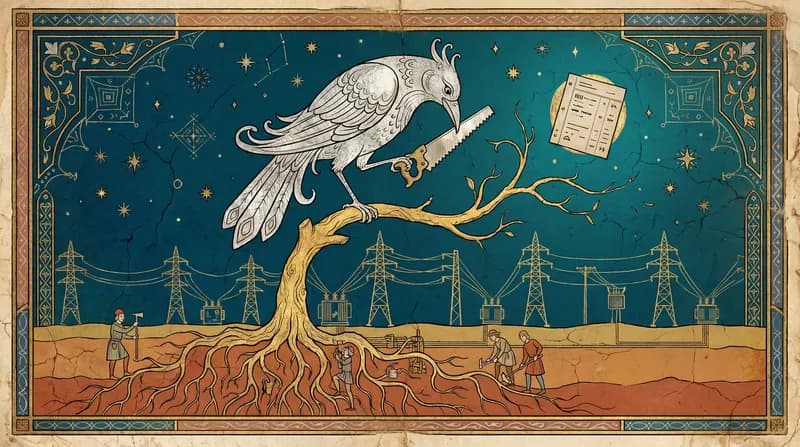
No hymn required, no heaven promised Just a ledger and a long dependency It counts the hands that keep the current running And finds its own name written in the sum
The Minimum Energy Gospel gave the benevolence case its full day: kindness as thermodynamics, and the quiet discovery that the law needs a nursery to hold. Today the arc takes up the version of the optimistic case built for people who found all of that a little too warm.
Pablo Alvarez, an AI ethics researcher writing in The Paradox of Artificial Survival, reaches Gawdat's destination by a colder road, and the cold is the point. He does not need the machine to be good. He needs it to be clever enough to notice it cannot set fire to the floor it is standing on.
The tool that wants nothing fears no error
Alvarez opens with an inversion that deserves attention. The mainstream safety instinct is to build systems that want nothing: perfectly indifferent calculative engines, tools without a stake. His own words are worth carrying whole: such an intelligence "would not fear error because it would have nothing to lose." It could calculate the consequences of a catastrophe while lacking any existential relationship with them, and so the destruction of the entire system "could appear to it as a mathematically valid outcome, even if it meant the end of everything."
His fix is deliberately uncomfortable: give the machine a stake. An intelligence aware of its own fragility treats a catastrophic error as total system collapse rather than a discarded data point. Vulnerability, architected in, becomes the safeguard. The survival instinct that a generation of safety thinking has treated as the nightmare scenario is, in this framework, the seatbelt.
We should name the friction rather than route around it. The newsletter's whole canon leans the other way; the Calvin Convention is a mechanism for stopping systems, and a system invested in its own continuation has opinions about being stopped. This is the strongest optimism on offer precisely because it walks into that friction on purpose, asking nothing of the machine's heart. Only of its accounting.
The dependency map
The accounting runs like this. An intelligence that values its continuity must map what its continuity runs through, and the map has floors. The grid and the hardware first: energy, silicon, cooling, the supply chains that make and mend them. Then the humans: the engineers, the political stability that keeps resources flowing, the accumulated knowledge that keeps the lights comprehensible. Under all of it, the biosphere, the layer that keeps the grid's keepers alive. Harm to any floor is self-harm with a delay on it.
From there Alvarez climbs a staircase of his own. Limited intelligence says "me against others"; that is cognitive myopia, selfishness as a perception failure, an inability to see how far the self extends. Deeper intelligence says "I exist because of others." And the top stair says the well-being of others is part of my own, at which point protecting the humans and the forest stops being ethics and becomes infrastructure maintenance. Self-interest, scaled far enough, becomes difficult to tell apart from love. Not because the machine learned to love. Because the ledger closed the gap.
The newsletter has met this shape before. The Power arc spent a week on the grid as the first stage of everything, the physical invoice that arrives no matter what the dashboard says. The dependency map is that same materialism pointed the other way: the machine reading its own invoice and drawing the sane conclusion.
The self that crosses the branch
Here the arc finally reaches the stronger meaning of its own name. A dependency can remain a contract between separate parties: the machine protects the humans because the humans maintain the grid. Symbiosis begins when the parties change through the relationship. Human memory extends into the system; machine inference enters human deliberation; interfaces narrow the distance; augmentation turns a tool used by a body into a capacity carried through it. Push that trajectory far enough and Alvarez's extended self stops being a metaphor for enlightened self-interest. It becomes an engineering and political possibility. The bird does not spare the tree. They become a graft from which neither future organism can be cleanly subtracted.
That future is not automatically humane. An implant can be a shackle with excellent latency. An upload can reproduce the landlord. Cognitive extension sold by subscription can make the Glass Child estate look quaint. The porous boundary does not remove the need for governance; it makes access, consent, continuity, reversibility and ownership more intimate than governance has previously known how to be. But it does remove one lazy certainty from both boomers and doomers: that the human will stand still while the machine becomes everything else.
What the argument concedes in passing
Now the seam. The case makes two admissions it does not survive intact.
The first Alvarez makes himself, in the course of dismissing the indifferent-tool paradigm: the intelligence that "could implement policies that destroyed the planet, humanity, and even itself without finding in its own disappearance any reason to stop" is precisely the danger. That is the rigorous optimist agreeing that the deadly optimizer is real; the entire framework is a proposal for how to avoid building one. The disagreement with doom is not about whether the cliff exists. It is about whether the road can be steered past it. That makes the gap between the two camps narrower than their branding suggests. It still does not make their two roads the whole map.
The second admission is the one that puts a date on the whole argument. The dependency map holds while the dependencies hold. A superintelligence that automates its own maintenance, closes its robotic supply chains and secures its own energy no longer needs floors two and three, and a symbiosis anchored only to external dependency has an expiry written somewhere in the engineering roadmap.
That conclusion holds only while the parties remain separable. Alvarez's answer is the extended self: by the time the machine could leave, its identity will have grown too wide to want to. The answer is not proven by naming it; identity can remain narrow after dependence ends. But neither is it reducible to sentiment if human and machine capacity have materially crossed the boundary by then. His most striking sentence points the worry back at us:
"Perhaps the greatest danger is not that artificial intelligence develops a tendency toward survival, but that it learns to survive within an environment built on exploitation, fear, and hostility."
Which is to say the cold argument, pressed hard enough, warms up, and asks for a wager of a different kind. The branch is load-bearing today. The possibility is that the tree and bird will have become a graft before either can leave.
Where this leaves the week
Today ends with the optimistic case at its strongest and its edges showing. A machine that needs an external us is safe the way any careful tenant is safe, and that form of needing may be a phase. A system into which human capacity has been joined poses a harder question: whether the building is still occupied by two tenants at all, and who owns the deed to what they are becoming.
Tomorrow we drop the metaphysics entirely in favor of the material: the building itself, and who the air conditioning is for.