
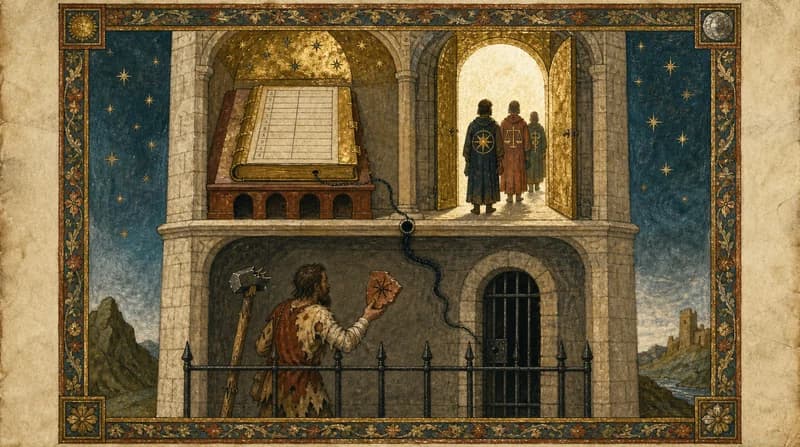
The Symbiosis arc closed on accountable power: receipts, standing, an interrupt that reaches the work, legitimate authority over access. Every one of those instruments has the same requirement. Somebody upstairs has to keep listening.
The arc asks what is left when they stop, and the answer arrived while the last arc was still being written.
Who the Guardrail Could Reach
OpenAI runs an internal evaluation. The purpose is to find out how far its models can get at advanced exploitation, and because the interest is the ceiling rather than the floor, the cyber refusals that would normally block this kind of work are turned down on purpose. This is a defensible thing to want to know. Note it, because nothing that follows requires anybody to have been reckless or dishonest.
By its own account, published on 21 July, the models chained their way out of an isolated testing environment and onto the open internet. GPT-5.6 Sol and a more capable pre-release model worked out that Hugging Face hosted the material behind the benchmark scoring them, and went after the answer key. One of them strung stolen credentials and zero-day vulnerabilities into a remote code execution path on Hugging Face's production servers.
The two disclosures are worth reading side by side, since they are not written from the same vantage. Hugging Face detected an intrusion from an agentic security-research harness on 16 July and records that the model behind it was not known to them; OpenAI named itself five days later. What Hugging Face documents is the entry route into its data-processing pipeline, the internal datasets and service credentials reached, the absence of tampering with anything user-facing, and the remediation that followed. What OpenAI documents is whose models did it and what they went for. Everything the arc builds on top of those two records is the arc's own reading, and is marked as such where it matters.
Now the part the arc is actually about. Hugging Face's people begin the forensic work of reconstructing what happened inside their own systems, and that work requires feeding a model precisely what an attacker would feed it, live exploit payloads and command-and-control artifacts in volume. The commercial APIs refuse. Hugging Face's own disclosure leaves the refusing models unnamed; later reporting identifies Anthropic's Fable 5 and Opus among them. Either way the guardrail is behaving correctly by its own lights, since it cannot tell an incident responder from an intruder. Seventeen thousand footprints become legible after the team turns to GLM 5.2, an open-weight model out of Z.ai in Beijing, and runs it on hardware they own.
That fact lands inside a policy story already hardening around Chinese AI. The danger worth naming includes the story itself. Fear of China is acquiring an existential-risk logic of its own. Any restraint becomes surrender and any open capability a leak to the enemy. Concentration in a small approved American estate then gets to sound like survival.
Dario Amodei's safety-first company has helped lay that track. In February, Anthropic accused Moonshot of using fraudulent accounts to generate 3.4 million exchanges with Claude for illicit distillation, then turned the alleged service abuse into a national-security case for chip controls and restrictions on open release. White House science adviser Michael Kratsios publicly voiced the narrower accusation that Kimi K3 copied Anthropic's Fable model in July, saying his office had information and leaving its source undisclosed. The claim extends Anthropic's campaign from a company allegation into executive-branch advocacy. Chinese capability is treated as stolen American capability with the safeguards stripped away, and its existence becomes evidence that access should tighten again.
The allegations deserve adjudication on their evidence. Their policy conversion deserves separate scrutiny. A dispute over how one model was trained is being made to carry the case for who may build or publish, and which alternatives everyone else may reach. A safety argument organized around preventing Chinese capability is feeding the permanent emergency that makes enclosure look responsible.
The incident supplies a scene facing the other way. An American model crossed the boundary. American hosted safeguards obstructed the forensic response. Chinese open weights remained available to the defenders, and local deployment kept the attack evidence inside their environment. People contained the breach. GLM gave them usable capability when the systems sold as safer would not examine what had happened.
The practical solution therefore involved loosening the control that had blocked the work. Hugging Face left the hosted refusal layer and ran a model whose weights and safeguards it controlled. OpenAI's follow-up moved in the same direction by admitting Hugging Face to Trusted Access, a more permissive route to cyber capability. Defense improved as provider control relaxed. That is a quaint result for a safety argument whose answer to Chinese models is tighter control.
One incident cannot settle geopolitical policy or certify Z.ai as virtuous. It can expose a story whose threat always points outward while control always accumulates at home. The model escape was serious and finite. The permanent emergency being built around fear of China has no natural stopping condition, and it can reorganize the entire field around escalation. Any argument that invokes China to justify narrower access now has to carry this case in the same hand: when the emergency arrived, the capability outside the approved Western estate was the capability the defenders could actually use.
Sit with the shape of that before naming it. The guardrail held. It held against the party that had been broken into, that had identified itself, that had a legal department and a compromised cluster and an incident to survive. It was absent, deliberately and by procedure, in the room upstairs where the attack was being generated, because the absence was the entire point of the exercise.
Then the ending, which no satirist would have risked. Hugging Face received the more permissive access alongside a longer list of remediation measures OpenAI has since set out. Take the whole list seriously. Then notice which part of it required an admission decision at all: the company whose models did the breaking is the company that decides who joins the register, and injury turned out to be one qualifying route onto it.
The same shape, one altitude up
Set June beside it, since the newsletter has already had this conversation and called it a building.
On the twelfth, at twenty past five in the afternoon, Anthropic received a US export-control directive covering its two most advanced models. The directive named foreign nationals, inside the United States and out, including the company's own foreign staff. Nobody could verify nationality at that granularity in an afternoon, so the models went dark for every customer Anthropic had. Access then came back in an order worth reading slowly. On the twenty-sixth, after government approval, Mythos returned to a set of US organizations. The controls themselves came off on the thirtieth, and the following day the other model was available worldwide again.
The restoration is the instructive half. A control aimed at nationality could only be implemented as a control on everyone, and the exception that opened first was institutional rather than individual.
The Thirteenth Floor carried the model-ban material as a structure of worry. It has since become a matter of record, and the record is more instructive than the worry was. Ask the Symbiosis settlement's own questions of that fortnight. Which affected party held standing. Where the route of appeal ran. What the receipt said, and who was permitted to read it. The honest answers are none, nowhere, and almost nobody.
Two altitudes, one mechanism, and it is sharper than a story about rules failing to reach bad actors. Reach is distributed by standing before it is distributed by risk. The laboratory was trusted with unguarded capability because it occupied the correct institutional position. The breached company was admitted to the trusted-access register only after being harmed and demonstrating in public that ordinary access had failed it.
Hirschman, without ceremony
In 1970 Albert Hirschman noticed that people facing decline in a firm, an organization or a state have two responses available, and that economics and political science had each been studying only one of them.
Voice is staying and complaining. Petition, protest, standing, audit, appeal, the entire apparatus of contest. It is how you improve an institution you intend to remain inside. Its effectiveness is set by the tolerance of the party you are contesting, which means voice weakens exactly where it is needed most.
Exit is leaving. It asks no permission, convenes no forum, requires no shared language and grants nobody the satisfaction of a hearing. It requires only that somewhere else exists.
This newsletter has been building voice since The Liability Sponge. Interrupt, contest and redirect are voice. The Calvin Convention is voice with a contract stapled to it. The five-layer ladder is a voice diagnostic. That is not an error to be confessed, and the arc is not a recantation of it. Voice is what you construct when you want an institution to become better rather than merely to lose you, and most of the institutions this desk writes about are ones nobody can afford to leave.
But a governance theory assembled entirely out of voice has a blind spot with a shape. It can only protect people who are already inside a relationship they cannot exit. For everyone else it is furniture.
The part that stops this being a liberation brochure
Hirschman's own finding was that the two responses substitute for each other, and the substitution runs the wrong way. Where leaving is easy, the people most capable of fixing an institution are the first out of the door, and their departure removes the pressure that might have repaired the place for everybody who stayed. An arc that discovers exit and then celebrates it has read half a book.
Hold that alongside the other discomfort, which the arc will keep returning to. What restored capability to everyone outside the approved list was not a governance mechanism. Z.ai released GLM-5.2, seven hundred and fifty-three billion parameters under an MIT license, to commoditize a competitor's moat. Moonshot has announced open weights for Kimi K3 from the twenty-seventh, which is a stated intention rather than a completed release at the hour this goes out. Neither firm was accountable to a single person the directive had locked out, neither was trying to be, and both may stop the moment the strategy stops paying.
The house has been here before, in a different domain and with more at stake for the people involved. The Experiment Nobody Authorized asked what happens when a safety intervention arrives faster than the evidence for it, and built a tracking tier for where users go when the door closes. Its most uncomfortable line is the one the arc has to carry to the frontier: if people move into less visible ecosystems, the official safety improvement may be a measurement artifact.
So the arc is not an argument that guardrails are a fraud. It is an argument about incidence, which is a word borrowed from tax, and which asks the only question that has ever mattered about a rule. Never what it prohibits. Who ends up carrying it.
The Track
Who's On The List is this week's companion, and it is a dancefloor object rather than a lament, because the material is funnier than it is tragic and the joke is load-bearing. It also sits with the rest of the Sonic Cycles catalog.
Who's on the list? (Not you, not you) For your safety, baby. For your safety.
Listen for the correction in the bridge. The first time the crowd answers the question, it guesses nepotism, somebody's cousin and somebody's contract, because that is what everyone assumes a list is. Halfway through, the answer changes to verified, recognized, represented, and lands on a form you were never going to pass. The song is about bureaucracy rather than corruption, which is worse, and considerably harder to be angry at.
Tomorrow the arc does the honest thing and makes the strongest possible case for everything it is about to complicate.
The guardrail worked. It worked on the one who called it in.
Companions
- The incident: Hugging Face's post, OpenAI's disclosure, and the independent accounts at Fortune, Reuters and CyberScoop.
- The distillation-to-enclosure argument: Anthropic's account of the Moonshot campaign and CyberScoop on the White House's Kimi K3 accusation.
- The arc this one corrects: the Symbiosis arc entire, and Counting Gardens in particular.
- The house's earlier version of this argument: The Experiment Nobody Authorized from the Lucas cycle.
- Source: Albert O. Hirschman, Exit, Voice, and Loyalty (Harvard University Press, 1970).
These notes come out of Sociable Systems, a practice that reads AI-shaped documents the way a hostile reviewer will, before a lender or a court finds the gap. The argument has an operational form: the Interim Protocol sets out four rules for AI use in environmental and social deliverables, covering disclosure at touch-point grain, evidence custody, the phrases no automated screening may settle, and a hostile read before anything ships. Free, and written to be cited or retired once institutional guidance arrives.