
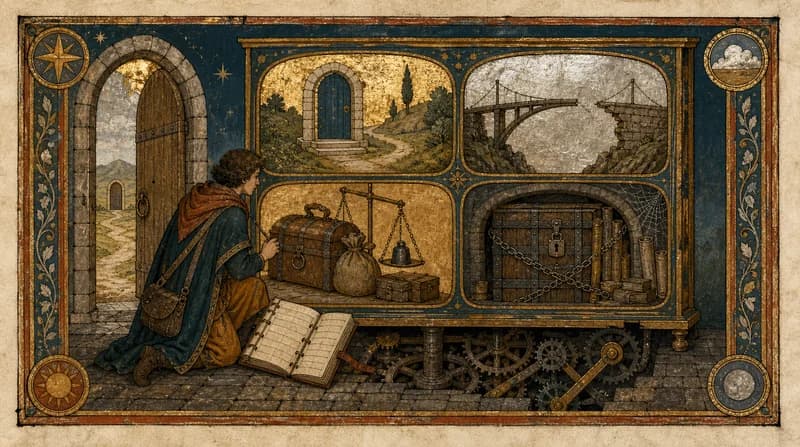
A door is only ever half a door The other half is somewhere it can lead They handed us the handle and the hinge And billed us for the room we'd never need
What Voice Costs left the week holding a narrow finding. Voice is granted, it measures only the people who stayed, and it fails when the powerful party stops needing you in the room. The obvious response is to leave.
Today the arc takes that obvious response apart, because exit is described in the literature as a freedom and it is nothing of the kind. It is a supply condition. Somebody has to have built the other room, and somebody has to own it.
Four tests, and most things fail two of them
Put the question to any particular person in any particular situation and it resolves into four.
Does an alternative exist at all? Not in principle. Actually, now, in a form that does the work. For most of the history of this newsletter's subject matter the answer has been no, which is why the canon went the way it went.
Can this person reach it? Existence and availability are different properties, separated by geography, language, legal jurisdiction, payment rails and whether the alternative's documentation assumes a reader who already knows.
What does the switch cost? Money, retraining, lost integration, and the quiet expense nobody budgets, which is the time of the people who have to be persuaded.
What cannot be carried across? History, most often. The record of what was decided and why. The tuning that took eighteen months of use to accumulate. A door you can walk through while leaving your memory on the other side is a door with terms.
Run June against those and the answer is genuinely mixed, which is the useful part. Take two positions, drawn as illustrations rather than reported cases. A developer routing through an aggregator switches providers in an afternoon and loses approximately nothing. An organization with eighteen months of workflow, prompt libraries, evaluation suites and a procurement process built around one vendor does not switch at all, and spends the fortnight explaining to its own people why the thing has stopped working.
Exit sorted by prior capacity. It always does. The people best equipped to leave were the ones least harmed by staying, and the ones who most needed the door got it last, if at all.
The floor under the floor
Now the part that stops this week becoming an advertisement for open weights.
Anyone may download GLM-5.2, seven hundred and fifty-three billion parameters. The MIT license is real, the file is there, and no register controls who takes it. What the license does not distribute is the ability to run the thing. Serving a model of that size at useful latency requires capital, accelerators, power and cooling, and the market for all four is consolidating along national lines while everybody argues about model access.
Z.ai's own material for GLM-5, the 744-billion-parameter sibling, documents support for deployment on Huawei Ascend hardware. Stop there, at what the company states rather than what the coverage infers, and the point still lands: the alternative building has a landlord too. Exit from the model layer arrives at the hardware layer and finds an owner waiting, with a different flag and the same economics.
The Thirteenth Floor described first access as an advantage that compounds. The inventory shows the advantage migrating rather than dissolving. It moves from who holds the model to who can afford to serve it, and the second question has a much shorter list of answers than the first.
The weights are free. The electricity has a landlord.
Symmetry, tested
What Voice Costs borrowed Tschernutter's rate ceiling to explain why voice weakens when the other party stops operating at human speed. His prescription follows directly and deserves the inventory rather than applause, since it is the most popular answer currently on offer and it is very nearly right.
The proposal is symmetry. Every person holds their own capability, accountable to them alone, representing their interests at the speed the institutions are already moving. He calls it a constitutional question rather than a technology debate, and on that he is correct. Concentration of this particular asymmetry does not require anybody to have bad intentions in order to be intolerable, which is exactly the argument this newsletter made about the thirteenth floor before there was an incident to point at.
Run it through the four tests and watch where it strains.
Does an alternative exist? Increasingly yes, and this is the strongest part of his case. Weights are downloadable, tooling is improving, and the gap between what a person can run and what a laboratory can run is narrower than at any point since this began.
Can this person reach it? Here the trouble starts, because his own framing supplies the word that gives it away. A trusted personal AI raises the question the whole week has been circling. Trusted by whom, and issued by whom, and revocable on whose decision. A personal capability supplied as a service by a party that can withdraw it is tenancy with better branding, and the Glass Child arc has already followed that arrangement to its conclusion. Symmetry that arrives through a vendor is not symmetry. It is a subscription to the appearance of one.
What does it cost? Symmetry of agents means symmetry of inference, and inference is where the landlord lives. A right to hold capability that nobody can afford to run is a right in the sense that everybody has the right to buy a data center.
And what cannot be carried? Rights are granted. That is what makes them rights. The instrument he is reaching for sits in the same column as standing and appeal, which means it requires an authority to confer it, an enforcement route, and a party who will still be honoring it in the year somebody actually needs it. June demonstrated how long a granted capability survives contact with a security concern.
So the diagnosis is excellent and the remedy has been filed under the wrong heading. The durable version of his argument is not a right to personal AI. It is a supply of capability that nobody has the standing to withdraw, which is a question about who maintains the floor rather than who signs the charter.
One further note, since the framing arrives with a picture attached. The material that carries this argument tends to be built around human versus machine, agency defended against capability. The Symbiosis arc spent a week taking that boundary apart, and the point survives here. The asymmetry is not between people and machines. It runs between people with capability and people without it, which is a much older story and one this desk knows the shape of.
When learning changes name
Before asking who supplied the alternative, clear one word off the threshold.
Knowledge distillation has been an ordinary machine-learning technique since the 2015 paper that gave the teacher-and-student arrangement its durable name. A student model learns to reproduce patterns in a teacher model's outputs. The teacher's weights and source code do not pass across. Anthropic's own account calls distillation widely used and legitimate, including inside frontier laboratories.
The company's allegation against Moonshot concerns a more particular arrangement. Anthropic says hundreds of fraudulent accounts generated more than 3.4 million Claude exchanges through several access routes. It says the campaign violated its terms and regional restrictions while attempting to reconstruct reasoning traces. Those details matter. A familiar learning technique can sit inside a contract breach or an access dispute, and a provider is entitled to close accounts that violate its rules.
The word stolen still gets ahead of the public record. White House science adviser Michael Kratsios says his office has information that Moonshot distilled Fable to develop Kimi K3. The evidence has not been published. US law supplies no rule under which model distillation is automatically intellectual-property theft. The Supreme Court's Van Buren decision rejected a reading of the Computer Fraud and Abuse Act that would turn every computer-use-policy violation into a federal crime. That leaves room for civil claims and fact-specific disputes about access after permission has been withdrawn. It does not turn a terms-of-service clause into a criminal statute.
Copyright refuses the slogan too. The US Copyright Office treats fair use in model training as contextual and explicitly warns that machine learning cannot simply be equated with human learning. The recent Anthropic book case adds a useful discomfort. Judge William Alsup held that training on lawfully acquired books was fair use. He separately held that downloading millions of books from pirate libraries to assemble a permanent collection was not justified as fair use on the summary-judgment record. The parties settled before trial on that issue, and the court has now approved the settlement. There was no guilty verdict for stealing knowledge.
The irony survives the correction. A frontier company benefited when a court distinguished learning from the acquisition of unlawful copies. When a cheaper rival learned from the frontier company's outputs, the distinction collapsed into theft and national security, supplying a renewed case for export control. At the top of the stack, absorption is learning. When capability flows outward, it changes name.
That change of name performs governance. It converts an alternative supplier into contraband and makes protecting the incumbent's moat sound like protecting the public. The question for this arc is wider than whether Moonshot broke a contract. It is whether a provider's terms may be promoted into a rule about who is allowed to learn, until every exit owes its legitimacy to the estate it threatens.
Jensen Huang supplies the missing American counterclaim, and his interest is gloriously visible. Nvidia sells the machinery beneath whichever model people run. Cheap open capability enlarges that market. Huang therefore told Axios that excellent Chinese open models should be used by American firms. He described distillation as fundamental to intelligence while preserving consequences for privacy or contract violations. The boundary he draws sits around the conduct, not the resulting model.
His security argument lands even closer to this arc. Open models can be inspected and defended by people outside the supplier. A world concentrated around one closed model inherits a single point of attack and failure. In a coalition letter published two days after the interview, Huang joined researchers and technology executives in arguing that American leadership depends on an open ecosystem alongside closed frontier models. Open weights give customers control and defenders access to comparable capability.
None of this turns Nvidia into a public institution. It clarifies the incentives. Anthropic's moat makes enclosure rational for Anthropic. Nvidia's market makes diffusion rational for Nvidia. Public exit presently depends on the second interest remaining profitable, because neither company has granted the public a right to the door.
Who supplied the door, and why
Which brings the week to the thing the canon has no vocabulary for.
The alternative exists because Z.ai put frontier-adjacent capability into the open for competitive reasons, with Moonshot announcing that it will follow. Making the layer above you worthless is an old strategy, older than software, and it has produced public goods before, by accident, repeatedly. Nobody at either company was thinking about the Hugging Face incident response team or about anyone locked out by a Commerce directive. The distribution was a side effect.
Take the benefit seriously and refuse the redemption arc in the same breath. A defector's interest points toward distribution this quarter and carries no obligation to point there next quarter. There is no covenant. Nobody signed anything. A gift that arrives as a by-product of strategy can be withdrawn the moment the strategy changes, and no affected party will have standing to object, because the entire point of this route is that it never involved granting anyone standing.
So the honest description of the current situation is uncomfortable in both directions. The most effective anti-feudal act of the year had no receipts, no named owner answerable to the affected, and no route of appeal. And the newsletter's settlement, applied strictly, would have scored it as ungoverned.
Plural estates
The conclusion the arc needs, and does not enjoy.
Several competing estates are not the absence of an estate. Anyone who tells you that competition has abolished the thirteenth floor is selling something, usually inference. What competition has done is give the stairwell a second door, at a price, for as long as the competition lasts, and while it lasts that is worth a great deal to anybody standing in the stairwell. It is worth nothing at all to the alignment problem, which now has more rooms to watch and less authority in any of them.
Both things are true. The arc will keep them both.
Tomorrow the arc finds out what happened when a company under attack tried to use the capability it was already paying for.
A door you cannot afford to walk through is a wall with better manners.
Companions
- The compounding advantage this episode relocates: The Thirteenth Floor.
- Where users go when the door closes: the Displacement tier in The Experiment Nobody Authorized.
- The estate that rents your capacities back: the Glass Child arc.
- Distillation as an engineering technique: the original teacher-and-student paper, alongside Anthropic's Moonshot allegation.
- The legal distinctions: Van Buren v. United States and the final approval order in Bartz v. Anthropic.
- The Kimi K3 claim and the commentary prompting this section: the Reuters account and Ruben Tech on whether distillation is theft.
- Jensen Huang's case for Chinese open models and targeted enforcement: his Axios interview and the coalition letter on Open Weights and American AI Leadership.
These notes come out of Sociable Systems, a practice that reads AI-shaped documents the way a hostile reviewer will, before a lender or a court finds the gap. The argument has an operational form: the Interim Protocol sets out four rules for AI use in environmental and social deliverables, covering disclosure at touch-point grain, evidence custody, the phrases no automated screening may settle, and a hostile read before anything ships. Free, and written to be cited or retired once institutional guidance arrives.