
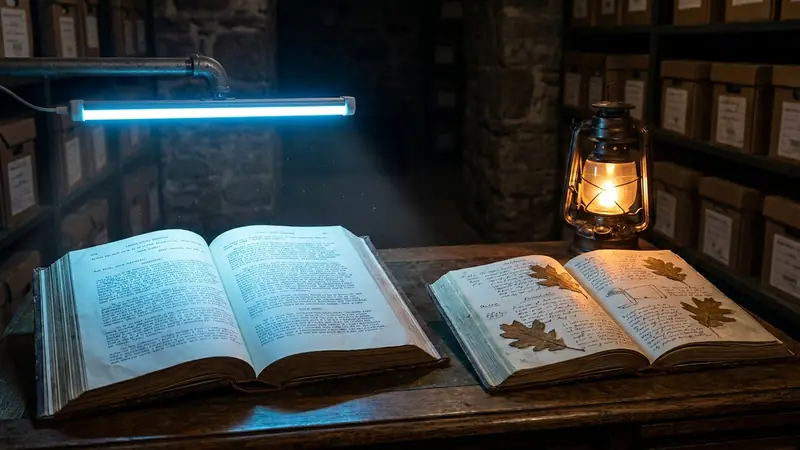
They wrote the date. They wrote the sign. They wrote who came and who was heard. The minutes hold the words that passed. The minutes do not hold the wood.
A consultation meeting was held in March about a project that affects a community. The company's record of it is accurate: the invitation, the date, the agenda, the attendance register, the questions people asked, the answers that were given. The community's account is also accurate: the invitation arrived with days rather than weeks to prepare, the meeting ran in a language only some of those present could follow, a third of the room left before the question session because the last bus went at six, and the objection a headwoman raised was minuted as a question. Neither record contains a lie. Each was built to notice different things, and each noticed faithfully what it was built for.
The company's record is a record of procedure. It answers: was there a meeting, were people invited, did they attend, were questions answered. The community's record is a record of the quality of the meeting. It answers: could people prepare, could they participate, was consent possible. A process that reads only the first document finds a consultation that passed. A process that reads only the second finds one that failed. Both readings come from the same evening.
Divergent frames
The disagreement runs at the level of the frame, and it takes almost no bad faith to produce. Each record-maker stood in the same room and recorded the part of it their role was built to notice. The company's note-taker was there to establish that a duty of consultation was discharged. The attendees were there to learn whether their land and livelihoods were safe. One account grew from a compliance question and the other from a survival question. No amount of good faith makes the two records converge, because they were never observations of the same object. They are observations of the same event through two instruments, and each instrument was working.
The claimant's memory of March and the institution's minutes of March have this shape. FPIC practice has lived with the problem longer than most: under UNDRIP, consent belongs to the community as a collective right, which means the account of whether it was given belongs with them, and no attendance register can settle the question on its own. Grievance-mechanism practice under the UN Guiding Principles meets the same shape from the other end: the effectiveness criteria ask mechanisms to be based on dialogue, and dialogue between parties holding different records is the normal case.
The uncomfortable finding needs no villain. A plurality of honest records is the ordinary output of an ordinary consultation, and the systems downstream of it all assume a single one.
What each record was built to notice
Any process that must decide between accounts has to know what each account was built for. A minute of procedure cannot answer questions about the quality of participation, because it was never an instrument for observing quality. A lived account cannot answer questions of date, attendance, or sequence with the reliability of a register, because it was never built as a register. Treating either as the single faithful record destroys what it is good at.
The practical form carries both records forward together, attributed, each with its frame named. That costs little and breaks almost every automated intake in existence. When two accurate accounts diverge, the divergence is usually information about what each was built to notice, and a procedure that cannot hold both has decided in advance, without a rule, which instrument gets to be the truth.
In the grove, the woodcutter and the policeman were each accurate about what their position let them see, and the commissioner who questioned them reconciled nothing. No office in the story ever holds all seven accounts. An office that could is the design problem from here on.
How the minute gets made
Minutes are written to a template, and the template already knows what it wants. Date, venue, attendance, agenda items, questions raised, responses given. A column for "issues raised" can hold an objection only by converting it into something the template recognizes, which is usually a question, because a question has an answer and an answer closes the row. The headwoman's objection became a question at the moment it entered the form. Nobody had to intend that.
The attendance register has the same habit. It counts the people who signed, and a signature records presence. It carries no information about whether the person could follow the language of the meeting or stayed until the end, and none about whether they understood that their name on the sheet would later be read as participation. Interpretation gets a line ("translation provided"), and the line says nothing about how much was translated or by whom. (In practice, by whichever staff member happened to speak the language, which is its own small governance story.)
The community's account has its habits too. It remembers the bus and the short notice vividly and the agenda vaguely, and it will sometimes fold two meetings into one. Those are the weaknesses of memory, and they are real. They are also weaknesses a well-run process can correct for: by reading the minutes back at the next meeting, by letting the community keep its own record, by noting the language each contribution was made in, and by asking the headwoman whether her words were minuted the way she said them. Each of those practices costs an afternoon. Each produces a second record on purpose, which is the thing every downstream system will then try to merge away.
Companions
- The comforters, the counterfeit plurality: Reasons Written After the Fact.
- The address both accounts arrived at: The Account Must Have an Address.
- The fiction: Ryūnosuke Akutagawa, "In a Grove", from Rashomon and Other Stories, on Wikisource.
- UN Declaration on the Rights of Indigenous Peoples (2007), Articles 19 and 32.
- UN Guiding Principles on Business and Human Rights (2011), Principle 31.
These notes come out of Sociable Systems, a practice that reads AI-shaped documents the way a hostile reviewer will, before a lender or a court finds the gap. The argument has an operational form: the Interim Protocol sets out four rules for AI use in environmental and social deliverables, covering disclosure at touch-point grain, evidence custody, the phrases no automated screening may settle, and a hostile read before anything ships. Free, and written to be cited or retired once institutional guidance arrives.