
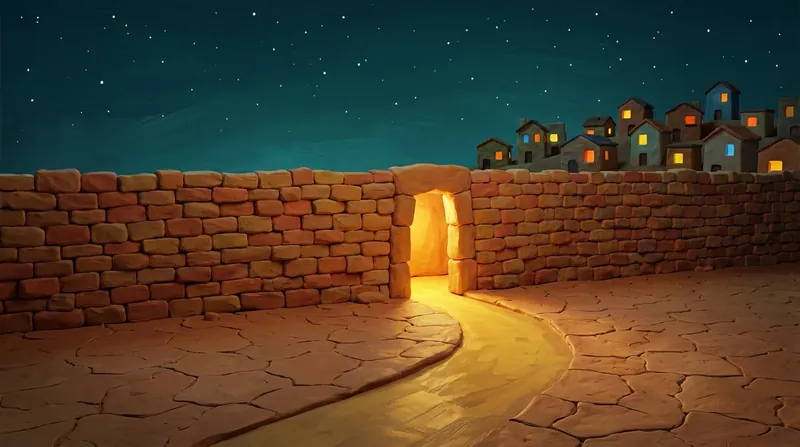
Arc Consolidation | Episodes 192–198
The Prescription and the Wall
The Humane Loop Arc is the prescription half of a two-arc pair. Where the Glass Child arc named the diagnosis (what working alongside the machine makes of us, and which capacities the ledger has been demoting), this arc builds the judgment layer that returns them.
The lens is Ursula K. Le Guin. Not the Earthsea wizard: the one who built a working society on the far side of a wall and spent the whole novel proving that the true journey is return. The one who asked what happens to the child who does not walk away from Omelas and instead stays to build something else. And the one who theorized the carrier-bag: a tool that holds and gives back, where the blade takes and replaces.
The arc rejects the human-in-the-loop as a liability sponge. It replaces it with a maintained society: the loop as a small working society you build by living it daily, not by declaring it once. The test is not whether the human has a seat. The test is capacity return: does the human leave the encounter more able to direct, contest, and refuse the system, or only better-supervised?
Key Movements
- The Wall (Ep 192): Sunday interlude. The track True Journey Is Return opens the arc in musical form: every image returns, changed, by the final chorus. Nothing is spent and discarded. The wall around the spaceport is low because the society on the other side did not need to keep people out. It needed to remind them that crossing was a choice. The wall is a door.
- Sweep the Temple First (Ep 193): Formation before access. Before a person is given a powerful tool, they must first carry the work the tool is supposed to assist. The temple rule is not sanctity. It is the room that teaches what the instrument does not know. The H∞P is praxis, not product. The Crossing Literacy module names the work that makes the human capable of holding the tool without being replaced by it.
- True Journey Is Return (Ep 194): The capacity-return test. A crutch relieves a burden without building the limb. Mastery builds the limb by carrying the burden. The loop that returns the human to the same tired, supervised version of themselves is a supervision regime with a signature field at the end. The human twin of capability regression is deskilling: the model gets more helpful, the workflow gets smoother, and the human gets less capable of directing the system because the system has learned to remove the friction that would have forced the human to think.
- The Ones Who Carry It (Ep 195): The hidden cost. Le Guin's Omelas is the frame. A bright city whose comfort is paid for by someone unseen, in a room nobody visits. The AI economy has its own basement: the verifier, the rater, the moderator, the queue-loader, the operator who clicks accept in a tempo that makes genuine deliberation architecturally impossible. The humane loop is not humane because it has a human in it. It is humane because it pays the verifier. The carrier-bag holds and returns; the blade cuts the human out of the value chain, then uses the human as a handle when the blade needs someone to blame.
- The Pantry and the Neighborhood (Ep 196): Memory hygiene. The pantry rule says the model's memory is not the organization's memory. The old assumptions must be checked at every encounter. The defense against normative drift is not better memory. It is a neighborhood: a multi-model ecosystem where disagreement is the signal, not the fault. Safety is an ecosystem property you maintain daily, not a guardrail you install once and check quarterly.
- The Loop That Governs the Loop (Ep 197): Governance architecture. The five-layer ladder (technical, workflow, contractual, institutional, ecosystem) asks a different question of the loop at each layer. The First Three Controls must be present at every iteration: interrupt, contest, redirect. The operator is not a personality type. The operator is a citizen of a maintained society, and the governance layer is the operational reality that makes the operator's interrupt survivable. The Calvin Convention is the wall as door: the boundary that is also a passage, because the contract is built to be crossed daily.
- Humans in the H∞P (Ep 198): Saturday synthesis. The week recapped from formation through governance, ending on the maintained society. The capacity-return test is not a one-time audit. It is a continuous practice. The loop that returns capacity today can become a supervision regime tomorrow if the pantry is not turned over, the neighborhood is not consulted, the verifier is not paid, and the operator is not protected. The arc closes where the track began: the same words, made communal by everything that happened in between. Nothing is spent and discarded. Everything is carried forward. Everything is carried slow.
Looking Forward & Backward
The Humane Loop Arc anchors backward to the Glass Child Arc (the diagnosis it is built to answer), the Partnership Dividend Arc (the H∞P architecture and the three seats), the Liability Sponge (what the loop replaces), the Power Arc (the physical invoice and the verifier at the switch), the Regression Arc (capability regression and its human twin, deskilling), the Optimization Arc (institutional preference and the comfortable disaster), the Contract Arc (the contract as the machine itself), and the Detection Arc (seam-reading before the evidence arrives).
Looking forward, the arc establishes that capacity return is not a destination. It is a maintained society. The maintenance is the work. The work is the praxis. The praxis is the Odonian society on the far side of the wall: you do not win the better arrangement by decree. You build it by living it daily. The hand-off to whatever follows is the same as the wall itself: low enough to step over, but the step has to change the walker.