
The last arc ended where diagnosis always ends: at the edge of a claim the week could not yet build.
The Claim laid the week end to end, from the schoolroom to the substation. The glass child had been named. The demoted capacities had been listed: judgment, refusal, context, care, memory, courage. The ledger had been shown to count the artifact, not the judgment that produced it. The arc closed on a single imperative: raise the other child before the counting hardens.
That was the diagnosis. This week is the prescription.
It is built on a different Le Guin than the one most readers reach for first. Not the Earthsea wizard, who wins by knowing the true name of things, and not the Hainish diplomat either. This week belongs to the Le Guin who built a working society on the far side of a wall and then spent the whole novel proving that the true journey is return. The one who asked, in a different register, what happens to the child who does not walk away from Omelas and instead stays to build something else. And the one who theorized the carrier-bag: a tool that holds and gives back, where the blade takes and replaces.
That is the lens this week is looking through. The tool that returns. The society built by living it. The wall that is also a door.
The Track
True Journey Is Return is the first of two companion tracks for the arc. The production is spare, communal, built from few materials that keep being reused and handed on. Hand percussion, breath, footstep, a low sub-bass drone, and a slow-blooming electronic pulse that thickens in texture rather than launching like an arrow. The lead vocal starts solitary and close-mic'd, almost spoken. By the final chorus it has become a gathered voice, as if other singers have joined one by one without anyone announcing the arrival.
The structural instruction is the arc's thesis in musical form. Every image introduced in the first verse returns, changed, by the final chorus. Nothing is spent and discarded. The opening line is sung alone at the very start. The same line, word for word, closes the song, but by then it is carried by many voices instead of one. The same words, made communal by everything that happened in between.
That is the carrier-bag theory as sound. The song proves by refusing to throw anything away.
Sweep the floor before you hold the key Carry the water, then come and carry me The wall was never only stone True journey is the road that circles home
The refrain is doing two things. It names the formation-before-access rule: the unglamorous work that earns a person the right to hold something powerful. And it names the wall as something other than a boundary. A wall can be a door. It depends which side of the work you are standing on.
From Diagnosis to Praxis
The Glass Child arc named what working alongside the machine makes of us. This arc asks what we make of the work.
The H∞P framework has been carrying an operational vocabulary for this question for some time. Humans in the H∞P names the move from loop to aperture: the partnership that stays open at every iteration rather than closing at the end of one. The AI-ESG practitioner track is its training surface. The Calvin Convention is its contractual layer. These were operational before the arc arrived. The arc is what happens when the operational vocabulary meets the literary one and both are asked to prove something.
The test is capacity return. Does the human leave the encounter more able, or only better-supervised?
A liability sponge is supervised. A sponge is watched, documented, signed-off, and then blamed when the gap between system claim and system reality finally surfaces. Supervision is what the institution buys when it wants the appearance of human judgment without the cost of human judgment. Capacity return is what the loop produces when the human actually becomes more capable of directing the system, and of refusing it when refusal is the right answer, because of the work they did inside the loop.
The difference is not a mood. It is a design property. And it is what the week is going to walk, one day at a time.
What the Week Builds
The opening move is formation. The schoolroom critique the Glass Child opened is not only an education argument. It is a formation argument. The fluorescent room trained people to be processable before the synthetic peer arrived. What replaces that training cannot be access to a better tool. It has to be the work that makes the human capable of holding the tool without being replaced by it. Sweep the Temple First asks what that work looks like when the syllabus is designed for it, not inherited from a century that needed compliant workers.
The second move tests capacity return. The Partnership Dividend arc built an architecture where shared strain produced insight. The question now is whether the strain produces the human, or only wears the human out. The crutch-versus-mastery distinction is the hinge. A crutch relieves a burden without building the limb. Mastery builds the limb by carrying the burden. True Journey Is Return asks which one the loop is actually doing.
The third move names the hidden cost. Le Guin's Omelas is the frame. A bright city whose comfort is paid for by someone unseen, in a room nobody visits. The AI economy has its own unseen rooms. The verifier who checks what the model produced. The rater who labels the training data. The moderator who absorbs the content the model will not touch. The queue-loaders and the contract-drafters and the people in the gap between design and reality. The Ones Who Carry It asks whether the humane loop is built on the same hidden burden it claims to replace.
The fourth move turns to memory. Human memory, which is the kind the vendors forget to mention. The pantry rule, the neighborhood of models, normative drift, and the hygiene that prevents a loop from calcifying into a habit. Safety is not a guardrail you install once. It is an ecosystem property you maintain. The Pantry and the Neighborhood asks what memory hygiene looks like when the loop is supposed to return capacity rather than just produce output.
The fifth move climbs to governance. The loop that governs the loop. Disagreement as diagnosis. The five-layer ladder. The First Three Controls. The operator playbook. The Loop That Governs the Loop asks whether the architecture can survive its own audit, not because the audit is hostile, but because the architecture has to be built to invite it.
The synthesis closes on the name the week has been earning. Humans in the H∞P is the synthesis: from liability sponge to reciprocity, from supervision to capacity return, from the loop that closes to the aperture that stays open. The loop as a maintained society, not a checked box.
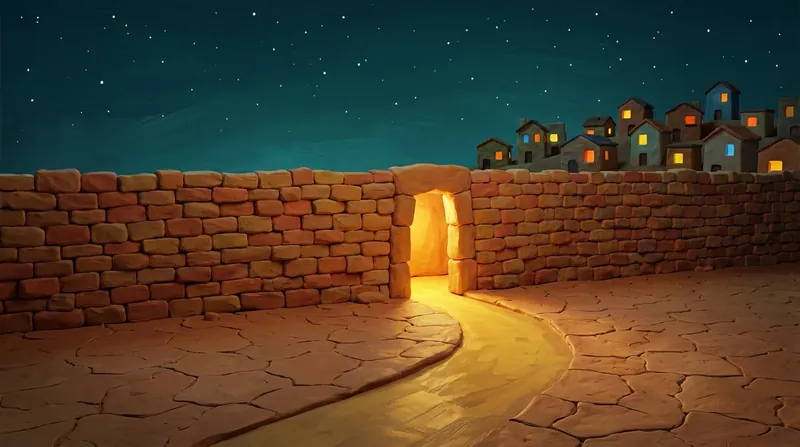
The Wall Is a Door
The Dispossessed opens with a wall. The wall around the spaceport on Anarres. It is low, unguarded, and almost anyone could climb it. That is the point. The wall is not there to keep people out. It is there to mark a boundary that has been chosen, not inherited. It is a door because the society on the other side built itself by crossing it daily, by living the arrangement rather than declaring it.
That is the move the week is making. The humane loop is not a better checkbox. It is a small working society you maintain. The test is whether the person who crosses it daily becomes more capable of the work, or only more familiar with the form.
The track will play, and the wall is low enough to step over. The question is whether the step changes the walker, or only the passport stamp.
The arc is about to begin.