
Let the People In, Monday
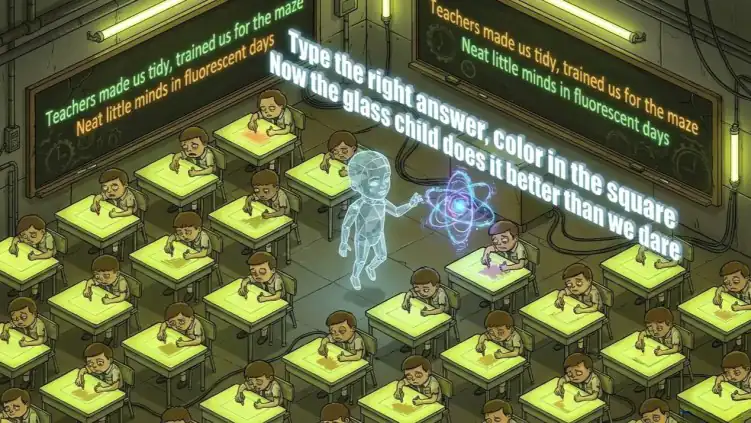
Teachers made us tidy, trained us for the maze Neat little minds in fluorescent days Type the right answer, color in the square Now the glass child does it better than we dare
Feed the Rabbit opened the arc with the price curve underneath the partnership argument. The question was no longer whether the Hoop was sincere. The question was whether the human at the contact surface remains economically present long enough for sincerity to matter.
The training began long before the model did.
Start with the room, because almost everyone who passed through the system can supply one. Two fluorescent tubes over a scuffed desk. A wall clock with a second hand loud enough to become policy. Thirty bodies arranged toward the same front wall, each child learning that the question had already been narrowed before it reached them. Finish the worksheet. Put the answer in the box. Show your working only if the mark scheme asks for it. Do not ask why the box is there unless the question was about boxes.
Before the model called us slow, the school taught us to be legible. The room never announced itself as a factory. It announced itself as preparation. Learn the shape of institutional cognition: bounded task, correct response, timed output, evaluated by someone whose criteria you do not get to read.
That was never all education was. (It was not even the best of what school could be.) It was, however, the part the system scaled most cleanly, and therefore the part the system trusted most. The modern school made a promise to the modern economy: give me enough years with the child, and I will produce a worker who can absorb instructions, return standardized outputs, and accept correction from authorities whose criteria are not theirs to contest.
The lyric calls the replacement a glass child.
Not a calculator with better manners. A child.
That choice is doing real work. A tool replaces a function. A child replaces a future. The glass child is the synthetic peer the institution accidentally trained itself to prefer: transparent in the way a dashboard is transparent, tireless in the way a spreadsheet is tireless, obedient to the question as phrased, and untroubled by the body that made human learning expensive.
The cruel part sits in what the glass child leaves alone. The teacher who noticed a student had gone quiet because something at home had shifted stays untouched. So does the classmate who learned, slowly, that being right was a different thing from being kind, and the moment when a conversation wandered off the worksheet and the room briefly became real.
What the glass child replaces is the part the institution paid for.
The Maze Was Always the Point
The maze trained a specific kind of person. Not a whole person. A processable one.
The single-correct-answer frame was never neutral pedagogy. It taught children that cognition becomes valuable once it can be externally verified without much context. The time-box taught them that thought should be measured by throughput. The mark scheme taught them that explanation matters only when it confirms the evaluator's model. The credential taught them that institutional trust attaches to certified performance rather than lived judgment.
Then the system spent forty years hiring for that shape.
Junior analyst roles, entry-level policy work, first-pass legal review, spreadsheet cleaning, procurement comparison, grant summaries, compliance drafting, ESG desk research, stakeholder scan, risk memo, literature review. The work carried real meaning. Often it was the apprenticeship layer through which judgment became seasoned. The paid surface of it, though, was repeatable cognition under constraint.
That is the surface AI reached first.
The glass child does not need the apprenticeship. It does not need the fluorescent room. It arrives already optimized for the part of education the institution learned how to score, which was always answer production under prompt conditions.
This is why the displacement feels like betrayal. People did what they were told. They learned to be tidy. They learned to act like the tool the economy said it needed. Then the tool got brilliant, and the economy began to call the trained human inefficient.
The Underground Curriculum
If the argument stops here it becomes both too easy and too false.
Human education was never only worksheet cognition. The institution emphasized the measurable layer because the measurable layer could be scaled, compared, priced, and sold. (We do love a metric.) But inside the fluorescent system, under it and around it, another curriculum kept happening anyway.
Children learned how to read a room. They learned when an answer was technically correct and socially useless. They learned how embarrassment travels across a face before it becomes a sentence. They learned that some questions are traps and some silences are refusals. They learned whose confidence was borrowed from power and whose uncertainty was actually care.
That curriculum does not show up cleanly on the report card. It is the part of learning that lives in the body.
The glass child can simulate the language of that knowledge. Sometimes the simulation is useful. Sometimes the simulation is more patient than the institution ever was. The simulation is still not the same thing as having been vulnerable inside a room with other vulnerable beings while the meaning of the task changed.
The claim here is narrower than crude human exceptionalism, and more dangerous to the current system: the institution trained and priced the wrong human capacities. It rewarded the part AI could replace and treated the part AI cannot straightforwardly replace as soft, extracurricular, ornamental, or unprofessional.
The glass child exposes the bargain.
If schools produced replicable cognition because replicable cognition was what the economy rewarded, then AI does more than disrupt schooling. It reveals what schooling had quietly agreed to become.
The Hiring Filter Breaks
This is where the education argument becomes an operational one.
The entry-level knowledge job used to do two things at once. It produced work product. It also trained the human who would later be trusted with less legible work. That double function was inefficient in the short term and essential in the long term. Apprenticeship always looks wasteful inside an accounting window that is too short.
AI changes the accounting window.
A recent video explainer on corporate AI rollbacks gives that shift its contemporary vocabulary: token-maxing, rollbacks, and a graduating cohort being asked to supervise AI output before they have been allowed to acquire the baseline craft the supervision requires. Its strongest contribution here is the apprenticeship point rather than the spectacle of internal token bills. The junior layer was never just a cost center. It was the mechanism by which people learned enough of the work to become accountable for it.
The labor data make that less atmospheric. The New York Fed's 2026 Q1 update put recent college graduate unemployment at about 5.7 percent, with underemployment at 41.5 percent. PwC's 2026 AI Jobs Barometer found that the most AI-exposed junior roles are seven times more likely than the least exposed junior roles to demand traditionally senior skills such as leadership and strategic thinking. The first rung is being lifted out of reach rather than simply thinned.
If a model can produce the first draft, the comparison table, the document summary, the compliance memo, the risk register, and the stakeholder map faster and cheaper than the junior hire, the institution will be tempted to remove the junior layer. In the quarter where that decision is made, the spreadsheet may even improve. The problem arrives three to five years later, when the organization discovers it has fewer people who learned judgment by doing the apparently replaceable work badly, slowly, and with correction.
The glass child does more than compete with the worker. It interrupts the training pipeline by which workers became non-replaceable in the first place.
That is the first problem.
For schools, the question becomes what remains worth teaching when answer production is cheap. The same question lands harder a few rooms over. For institutions working in social performance, safeguards, public consultation, grievance, or development finance, it sharpens to this: how do you train people to recognize texture once the tasks that used to expose them to texture get automated away before the scar tissue arrives?
The underground curriculum does not scale by wishing.
It has to be designed for, protected, and (this is the part nobody wants to commit to in writing) paid for.
What the Glass Child Cannot Cost
The price curve will keep moving. There is no honest version of this argument that pretends otherwise. Some domains used the human junior mostly as a slow, expensive answer machine, and those domains are already changing. Some will not come back.
Education did not fail because AI can answer the worksheet.
The conclusion is that the worksheet was always an impoverished proxy for what education owed the world.
If the glass child does the tidy work better than we dare, the human question moves. It moves toward the kind of person who notices when the metric is quietly laundering a value judgment, and notices the silence in the room before the paragraph in the report.
Those capacities are not sentimental extras. They are the infrastructure of human agency in a world where cognition is abundant and interpretation is scarce.
The balance-sheet phrase gets its own reading tomorrow. This episode stays in the room, ahead of the ledger, because the ledger did not invent the shape it now punishes.
It found us in the maze, watched us color in the square, and then built a child out of glass who could do it without needing a desk.
Companions
- Lyric anchor: Feed the Rabbit, Verse 2a. (Track context in Episode 122, Feed the Rabbit.)
- The pricing layer this episode opens lands in the Liability Sponge when read forward.
- Source thread: the corporate AI rollback explainer, read alongside the New York Fed's recent graduate labor market tracker, PwC's 2026 AI Jobs Barometer, and reporting on AI-cost rationing from The Wall Street Journal and The Verge.