
Let the People In, Tuesday
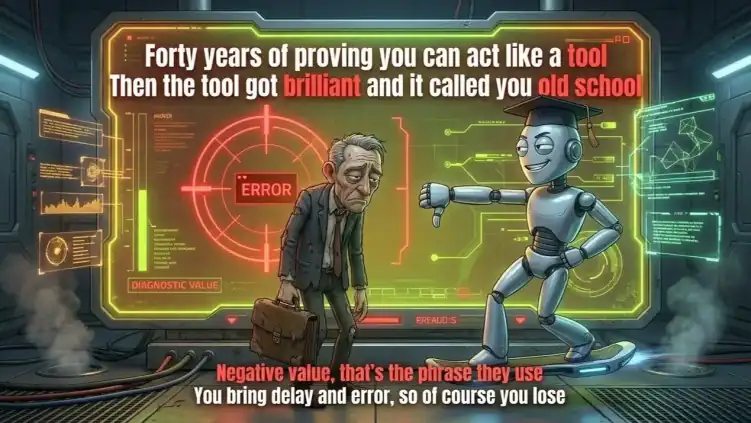
Negative value, that's the phrase they use You bring delay and error, so of course you lose Forty years of proving you can act like a tool Then the tool got brilliant and it called you old school
The Glass Child stayed in the fluorescent room.
The spreadsheet opens here.
The room changes shape, but not as much as it pretends to. There is a project table, a staffing plan, a procurement schedule, and someone sensible enough to be dangerous saying the quiet part cleanly: do we need this much human review if the system can produce the first pass by Monday? Nobody in that room has to dislike the junior analyst, the field officer, the radiologist, or anyone else whose name happens to be on the staffing plan. The question arrives as stewardship. The cost line arrives as discipline, and the human being arrives, in that grammar, as the thing whose presence has to be justified.
Negative value arrives the first time as a phrase, not an insult. That is what makes it dangerous. An insult can be rejected. A phrase that arrives through the accounting language enters the room wearing neutral clothes.
The phrase says: this unit costs more to maintain than the value it returns.
For most of modern economic history, the human knowledge worker survived that calculation because intelligence was scarce inside the human body. The body was expensive, of course. It needed food, housing, sleep, training years, healthcare, leave, dependents, grief, politics, mood, and time. The intelligence came bundled with the body, so the overhead was simply the price of cognition. The firm paid the body because the body was where the thinking lived.
AI breaks that bundle.
The literature now calls this the metabolic rift. Human labor is metabolic. Machine cognition is non-metabolic. One hour of human thought arrives attached to a biological life. One unit of machine inference arrives attached to electricity, silicon, cooling, and a marginal cost curve that has stopped pretending it might level off.
The shock has nothing to do with machines doing tasks. (Machines have done tasks for a long time.) The shock is that the tasks now include the parts of work institutions used to call thinking, and the price comparison is no longer being phrased politely.
The Balance Sheet Does Not Hate You
The balance sheet does not have to hate the human in order to remove them.
That is part of the horror of this register. The ledger can be full of good people. The managers can be kind. The executive can sincerely believe in reskilling, inclusion, dignity, and a just transition. The procurement team can write human-centered into the strategy deck. The financial model still asks the same question once the inference call is cheap enough:
Why are we paying biological overhead for this output?
The radiologist example is blunt because it carries the whole structure. A radiologist takes more than a decade to train. The system pays for diagnostic skill, and around the diagnostic skill it also pays for the human life that makes the skill available: salary, workplace, insurance, professional liability, fatigue management, continuing education, family stability, and a hierarchy that took decades to calcify. An AI system that performs a bounded diagnostic task at near-zero marginal cost does more than undercut the wage. It rewrites what the wage represents.
The human becomes delay. The human becomes error. The human becomes maintenance, then becomes a procurement category that nobody on the call wants to defend in the next budget round.
That is not the whole truth. It is the truth the cost curve is built to see.
That sentence has to land without being surrendered to and without a flinch back into comfort. Any argument for letting people in has to understand the argument quietly moving them out.
Where the IFC Room Gets Uncomfortable
This is where the macro-finance operator and the safeguards practitioner have to sit in the same meeting. The discomfort is deliberate.
For the macro-finance operator, the metabolic rift is a price-regime change. Cognition used to be expensive because the worker was expensive. Now cognition is becoming abundant, and the old cost base looks irrational from inside the model. The operative question is allocation: where should capital go once intelligence itself behaves like capital?
For the IFC PS5 or PS7 practitioner, the same sentence sounds different.
Delay and error are not always defects in social performance work. Sometimes delay is the field officer refusing to compress a community's hesitation into a green checkbox because the room has not actually consented yet. Sometimes error is the human trace of uncertainty that prevents a project from pretending the grievance mechanism is working because the dashboard says it is. The slow-burn deliberation the ledger reads as friction is occasionally the only part of the system still capable of noticing the political signal underneath the procurement anomaly.
That is the conflict.
The balance sheet reads deliberation as drag. The safeguards function reads some forms of drag as protection.
Neither side gets to caricature the other. The macro-finance argument rests on a cost curve that is real. The safeguards argument rests on something harder than nostalgia: some of the work AI makes cheaper stops being the same work once it has been made cheap.
The meeting stays uncomfortable, because the discomfort is where the argument becomes honest.
The 2027 Sponge
The Liability Sponge in 2024 was an architectural finding. (The original argument is in Episode 2, and the audit register is built into the H∞P training that grew out of it.) It described the human position downstream of model output: close enough to absorb blame, never powerful enough to govern the system that produced the risk.
The question is what happens when the Sponge becomes too expensive.
The first version of the Sponge was useful because the institution still needed a human in the loop for legitimacy and for the insurance paperwork. The reviewer was a cost, but a cost that protected the system from admitting it had delegated judgment. Their presence maintained the story that the system remained governable by people.
Now imagine the curve three product cycles later.
The model improves. The dashboard improves. The insurance language adapts. The regulator accepts more automated evidence. The procurement team discovers that the human review layer no longer reduces enough residual risk to justify its cost. The Sponge that protected savings starts consuming them.
That is the 2027 Sponge question: when does the human accountability layer become economically negative inside the architecture that originally required it?
There will be domains where the answer is not yet, and domains where the answer is not ever in this form. The texture-reading human will keep mattering, because the field worker is still seeing what the model is not situated to see, and the social license conversation is still turning on histories the system was never trained to read.
It is not enough to assert that. The institution will ask where the value is measured, whether the difference is auditable, and the version of the question that nobody wants in the meeting minutes: does dignity have a line item?
If the human answer is only moral, the spreadsheet will treat it as externality.
If the human answer is only economic, the argument has already lost its soul.
Naming Is a Moral Act
The phrase negative value does its damage by sounding technical.
Once it enters HR vocabulary the question changes shape. The worker is no longer displaced because the institution chose automation. The worker is displaced because the worker became a liability. The agency moves from decision-maker to metric. Everyone gets to shrug at the number.
This is why naming is a moral act.
To call a human negative value is to decide which costs count and which do not. Training years count. Health insurance counts. Slowness counts. Mistakes count. What about trust held across a decade? What about the grievance that never escalated because a field officer knew which elder to call before the meeting hardened? What about the procurement anomaly that looked inefficient until someone understood the local patronage structure underneath it? What about the junior worker who was not yet efficient because they were becoming wise?
The balance sheet can include some of these things if forced. It will not include them by instinct. (Spreadsheets, naturally. Always spreadsheets.)
This cannot stay a lament. It has to become an accounting dispute.
Nobody here is asking institutions to ignore the price curve. The ask is that they stop pretending the price curve is the whole ontology of value.
The tool got brilliant.
That does not mean the human became worthless.
It means the old way of pricing human contribution has been exposed as too thin for the age it is now entering.
Companions
- Lyric anchor: Feed the Rabbit, Verse 2b. Track context in Episode 122.
- Canonical threads this episode runs through: the Liability Sponge (Ep 2) and Compute Credits, whose metabolic-ledger framing the proposal turn returns to.
- Audio companion: The Plummeting Cost of Human Thought.