
Monday · Glass Child Arc · Episode 186
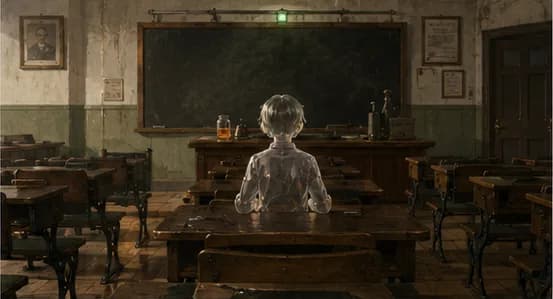
The child is sitting perfectly still.
That is where the week begins. Not with the machine, not with the product demo, not with the executive memo announcing the new operating model, not with the nervous webinar titled something like How to Stay Relevant in the Age of AI. Those come later. They matter. But the first scene is older than the model and colder than the office.
A classroom. Fixed rows. Hands flat on the desk. Children looking forward at a teacher outside the frame.
The photograph looks ordinary because the century succeeded. We have been trained to see that posture as education. A room full of children sitting still, facing front, producing the same kind of answer in the same time window, has come to look like learning rather than processing. The desks are bolted down, but the violence is quiet enough to pass for order.
This is the first machine.
It is not a silicon machine. It has walls, bells, timetables, report cards, handwriting exercises, answer sheets, seating plans, inspection days, and the adult voice that says stop fidgeting, answer properly, show your work, stay inside the lines. Its product is not knowledge. Not exactly. Its product is the kind of person an institution can read.
Quiet when quiet is required. Audible when called. Promptly responsive. Easy to evaluate. Easy to rank. Capable of translating a messy interior into a legible artifact the system already knows how to reward.
The child this produces has a name the institution did not need to say out loud.
The Glass Child. Transparent. Useful. Well-shaped for the form. Visible as output, invisible as life.
The Glass Child is not a person. That distinction matters from the start. No actual child is only this. No actual worker is only this. Human beings keep their strange weather, the shifting inner conditions no report has a column for. They notice things they were not supposed to notice. They carry loyalties, irritations, private forms of intelligence, stubbornness, tenderness, shame, and the capacity to refuse a category that makes the room easier to manage by making the truth smaller.
But a role can be trained hard enough that people begin to mistake it for themselves. That is what the schoolroom did.
Kazuo Ishiguro’s Hailsham is useful here because it understands that extraction does not need to look brutal in order to be complete. The children in Never Let Me Go are not raised in a dungeon. They are raised with art, guardians, friendships, rumors, longing, and a thin hope that if they can produce the right evidence of interiority, the system may recognize them fully enough to spare them. The horror is not that nobody can see their humanity. The horror is that seeing it does not interrupt the use to which they have been assigned.
Hailsham is a prototype for a particular moral arrangement: form the child well enough to look cared for, make the child legible enough to be used, then let the machinery continue.
That is why the schoolroom belongs in an AI arc.
The machine did not invent the Glass Child. The machine arrived after the training had already succeeded.
For a long time, the bargain looked stable enough to build a life on. Sit still. Follow instructions. Produce acceptable work on command. Translate mess into format. Learn the grammar of the expected answer. Deliver it in the expected register. Do this well enough and the institution may offer security. A job. A title. A mortgage. A path. Another quarter of standing.
This was called education. Then employability. Then professionalism. Then productivity. Then merit.
It did not always feel like diminishment. For many people, it felt like escape. The child who learned the code could leave the small town, the dangerous household, the badly paid work, the field, the factory, the unstable edge. The legibility regime had doors in it. A test score could become a scholarship. A credential could become a salary. A salary could become a roof that did not leak.
The bargain was not fake because it was narrow. It worked for many people. That is part of why it held.
But the contract was more exact than its moral language suggested. The institution did not promise to love the whole person. It promised to buy the artifact.
The memo. The spreadsheet. The compliance report. The board pack. The lesson plan. The summary. The polite refusal. The properly formatted answer.
The Glass Child grew up and found that adulthood was the same exercise with better lighting. Performance reviews were report cards with catering. KPIs were quizzes with money attached. Professional development was a syllabus written by procurement. The office did not abolish the classroom. It scaled it.
Then the synthetic peer arrived.
It could produce the legible artifact faster than the Glass Child, cheaper than the Glass Child, and without the metabolic inconvenience of being alive. No rent. No exhaustion. No childcare. No aging parents. No sick days. No body to comfort, feed, insure, or rest. No private grief pressing against the deadline. It could draft the memo, reconcile the table, summarize the transcript, clean the prose, produce the first pass, and maintain the tone.
This is why the disruption feels so intimate. The machine did not come for the wild, unruly part first. It came for the part the institution had praised.
The good student part. The helpful associate part. The part that never missed a deadline. The part that learned to sound calm while judgment was being removed from the room.
The usual reassurance arrives quickly here, wearing the clean shoes of managerial optimism. The machine handles the boring stuff. Humans will move up to higher-order work. Creativity. Judgment. Strategy. Empathy. Critical thinking. All the warm, difficult, context-laden things that make a person more than a processor.
The reassurance is not entirely false. It is worse than false. It is partly true, and therefore able to hide the harder problem.
There is higher-order work above the legible artifact. Of course there is. Anyone who has actually done difficult work knows this. The report is not the work. The report is what survived the work. The meeting note is not the work. The note is the fossil. The strategy deck is not the work. The work lives in the tense room before the deck, in the trade-offs, the refusal to accept the available category, the timing of the question, the sense that the silence after the third agenda item means the decision was already made.
The problem is that the Glass Child was trained out of that layer.
The child who paused too long was marked uncertain. The child who asked why the question had been framed that way was marked difficult. The child who noticed that the adult in the room was lying was marked rude. The child who refused to write the essay in the assigned shape was marked uncooperative. The child who felt the category was wrong before they could prove it was marked impulsive, emotional, inattentive, arrogant, insufficiently disciplined.
The old regime did not erase those capacities. It demoted them. It made them feel like faults. Then the economy discovered that those faults were the only moat left.
This is where the photograph changes temperature. The hands flat on the desk are not merely an image of discipline. They are an image of a long economic bet. We trained the visible part. We rewarded the measurable part. We built institutions that could process the legible part. Then we built a machine that could perform the legible part without asking to be seen as a person.
The dashboard has already turned green. The water in the jar has not changed color.
That image matters because it gives the legibility regime a body. A municipal chamber. Three glass jars on an oak table. Upstream water, outlet water, tap water. A director of water safety looking at the dashboard instead of the jars. The system says the project is a success because the system has only been taught to count what the sensors detect. The orange water is not invisible in the world. It is invisible to the instrument.
The Glass Child lives inside that same error., Visible as output. Invisible as life.
The system can see the artifact. It can count the deck, the report, the throughput, the signed log, the closed ticket, the generated response, the green compliance status. It cannot see the hesitation in the throat. It cannot see the pattern-sense that notices page nineteen is too neat. It cannot see the courage it took not to click approve. It cannot see the cost of staying human inside a room optimized for compliant production.
Yesterday named the line this week will keep returning to: the ledger counts the artifact, not the judgment. Today we name the role before the ledger mistakes it for the person. The Glass Child is the worker made transparent to the institution: easy to evaluate, easy to compare, easy to optimize, easy to replace once the artifact becomes cheap.
But the Glass Child is not the whole human being. That is the hinge and the hope. The role can be commoditized. The person carries other things. The next question is whether those other things can be promoted before the counting hardens.
For today, keep the classroom in view. The desks bolted to the floor. The teacher outside the frame. The children looking forward. A hundred years of asking why they sat so still.
We are about to find out.