
Tuesday · Glass Child Arc · Episode 187
Every formal curriculum has a shadow.
It runs in the corridor, under the desk, behind the official answer, in the long second before the child decides whether to say what the teacher wants or what the room has made obvious. It is not printed in the workbook. It is not assessed in the exam. It has no rubric, no badge, no certification pathway, no cheerful continuing-professional-development portal with a progress bar.
It teaches the things the assigned curriculum cannot grade and often punishes. Call it the Underground Curriculum.
The first curriculum teaches the Glass Child to be legible. Sit still. Answer in the right shape. Translate your messy noticing into the clean artifact. Learn which kind of intelligence the room rewards, then perform it before the timer runs out.
The Underground Curriculum teaches the other child. The one who hears what is missing from the sentence and notices who has not spoken. The one who feels the category fail before the evidence is ready. Who can hold two true things at once without forcing them into a tidy third thing for the sake of the report. The one who does not mistake speed for confidence. This child was not always praised. Very often, this child was corrected.
The pause was called hesitation. The hesitation was called weakness. The question was called disruption. The refusal was called attitude. The capacity to read the room was treated as distraction from the page. The capacity to know when the page was lying was treated as failure to follow instructions.
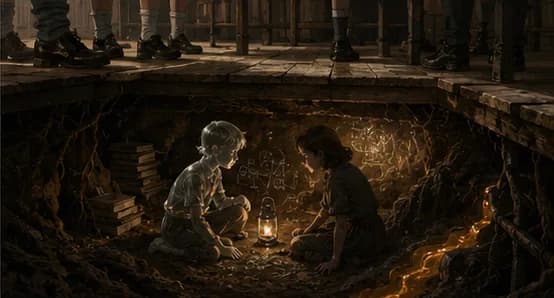
The old regime needed the Glass Child, so it trained the other child into the basement. That worked while the legible artifact still had a buyer. Now the artifact has been commoditized, and the basement is where the value is.
This is the cruel joke inside most future-of-work advice. The reassurance memo says humans must move toward higher-order work, but the advice industry keeps selling lower-order certainty in upgraded packaging. Learn the tool. Master the prompt. Take the course. Earn the certificate. Add the badge. Become fluent in the new workflow. Move fast enough and you will be safe.
Some of this is useful. Specifiable skills are not worthless. People should know how to use the tools around them. Refusing to learn the instrument is not dignity. A person who cannot drive because they object to roads is not liberated. They are stranded.
But a baseline is not a moat.
Every competence that can be fully specified is already standing out in the weather, exposed where the machine can reach it. The moment a skill can be packaged as a repeatable method, sold as a course, assessed through a checklist, and demonstrated through a polished artifact, it enters the same machinery that took the last layer. The skill may remain necessary. It stops being protective.
The trap is recursive because the Glass Child asks for rescue in the grammar that made it vulnerable. Tell me what to learn. Give me the list. Show me the path. Tell me which skill will be safe. Put it in a syllabus. Let me complete it.
The correct answer does not sound like an answer because it cannot be bought in that form. The moat is not a prompt, or a tool stack. It is not a laminated framework for becoming more human in six weeks.
The moat is a posture acquired slowly in the presence of people who have it. It is apprenticeship, not certification. It is being trusted with situations before you can fully explain what you are seeing. It is sitting beside someone who knows when the document is too clean, when the stakeholder map is missing the person who will matter, when the town hall report has translated refusal into “healthy debate,” when the silence at the end of the meeting is the decision.
The Underground Curriculum is full of these unglamorous capacities. Hesitation, first.
The formal curriculum likes the quick answer because quick answers are easy to score. The office likes the quick commitment because quick commitments make planning feel real. The machine likes the quick completion because completion is what it does.
But hesitation carries information.
Sometimes the question is wrong. Sometimes the frame is wrong. Sometimes the person asking knows the answer they want and is using the meeting to manufacture consent. Sometimes the next sentence would be harmful if spoken too soon. Sometimes the right answer is the one that can only arrive after the body has walked away from the screen and let the contradiction settle.
Then reading what is not said.
The transcript records the words. The room carries the event. A person can say “no objection” in a way that means there will be an objection later. A board can approve a plan while signaling that no one intends to defend it when the cost arrives. A community meeting can end peacefully because the person with authority left early and took the real decision with them. A parent can ask a practical question while listening for whether the school has already written off the child.
The synthetic peer receives the transcript. Or worse, it receives the summary of the transcript, or the summary of the summary. By the time the situation becomes legible enough to enter the model, much of the information the Underground Curriculum was tracking has already been removed.
Then refusal of category.
Institutions love categories because categories make action possible. A category can allocate a benefit, assign a risk score, trigger a review, route a ticket, fill a dashboard, satisfy a funder, close a case. The category is not always malicious. Often it is how the machinery keeps from drowning.
But every category has a boundary, and every boundary creates a remainder.
The Underground Curriculum trains attention to the remainder. The case that almost fits but does not. The student whose behavior is not a discipline problem. The worker whose “performance issue” is actually a design failure. The community concern that turns out, on inspection, to be an early warning rather than misinformation. The orange water that does not fit the sensor suite.
The formal curriculum says choose the closest option. The Underground Curriculum says stop the form.
A system that cannot hear refusal becomes brittle. A system that cannot tolerate hesitation becomes reckless. A system that cannot read context becomes predatory without needing anyone inside it to be cruel. A system that cannot notice the jagged detail will keep producing green dashboards over orange water and call the result scale.
The trouble is that these capacities are hard to hire for because the institution that needs them often has no category for them. The HR system wants a role code. Procurement wants a deliverable. The client wants a scope. The manager wants evidence. The reviewer wants to know how long it will take and how success will be measured.
The Underground Curriculum does not fit easily into that machinery. It shows up as the person everyone asks to sit in on the difficult call. The person who can read the hidden risk in a polite email. The person whose notes seem odd on Tuesday and indispensable six months later. The person who knows which stakeholder is absent from the room and why. The person who says, quietly, that the model’s answer is coherent but not true. The person who asks to see the water.
This is why today has to sit between the schoolroom and the ledger. Yesterday we named the Glass Child as the role that got trained. Today we name the capacities that survived under the role. Without that distinction, the argument becomes either despair or nostalgia.
Despair says the machine can now do the work, so the worker is finished. Nostalgia says the old work was humane and must be preserved. Both are wrong.
The old work often was not humane. Much of it was already narrowed, performative, extractive, absurd. Much of it rewarded elegant obedience and punished the very judgment it now claims to value. But the worker was never only the work. The person inside the role carried more than the artifact.
That “more” is not magic. It is not soul-talk as an escape hatch. It is not a vague glow around human specialness. It is a set of concrete, embodied, situated capacities that were demoted because they did not help the old machinery process people at scale.
They can be promoted again.
Not by pretending that every human naturally possesses them in equal measure. Not by turning them into another badge. Not by launching a taskforce to study them. Not by asking the Glass Child to buy a certificate in not being a Glass Child.
They are promoted by designing institutions that need them, notice them, pay for them, and protect the time in which they operate. They are promoted by restoring apprenticeship where the first rung has been cut away. They are promoted by making the room matter again.
This is where the replicability trap closes.
The formal syllabus taught what could be replicated. The replicable became the credential. The credential became the job. The job became the artifact. The artifact became the thing the machine could produce. The worker then asked for a new replicable credential to escape the collapse of the old replicable credential.
The exit is hard to find because it does not look like an exit. It looks like slower work. It looks like apprenticeship. It looks like being in the room. It looks like the courage to let an answer remain unfinished until it becomes true.
The ledger will not like this. It has no column for hesitation. It has no field for the person who sensed the issue before the incident. It can count the delivered report. It cannot count the report that should not have been delivered.
Tomorrow, the ledger takes over. For today, keep the basement in view. Under the schoolroom. Under the performance review. Under the webinar. Under the badge. Under the prompt guide. Under the perfect artifact.
The other child was not gone. The other child was demoted. And what the syllabus punished may now be the only moat.