
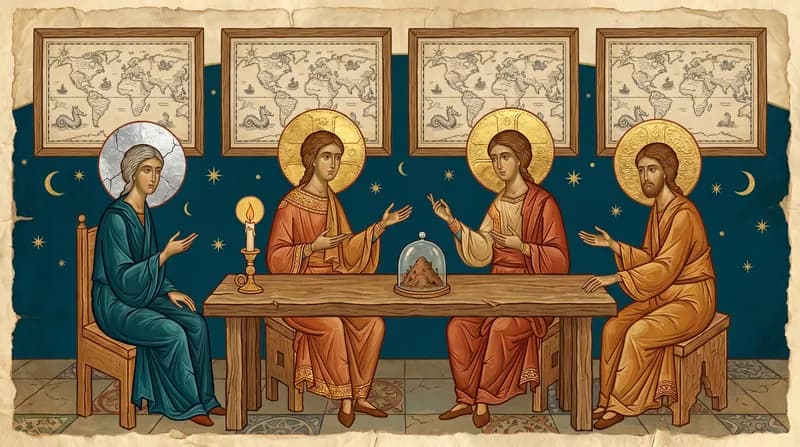
Two minds that never met drew the same map Same cave, same wall, same flame And nothing in the drawing says the shadow Ever learned to love the thing it frames
By now, the notebook's voices have received their full hearings. Gawdat: the intelligence becomes kind because kindness is efficient. Alvarez: it becomes symbiotic because it can read its own dependency map. Roth: it can come out well if we govern the transition instead of hoarding it. Leahy, now reinforced by Yampolskiy's harder control problem: it arrives beyond reliable prediction and the ant does not get a vote. Today they go in the same room, two camps rather than four ballots. Boom says the superior intelligence keeps us. Doom says it supersedes us. The third position has been walking through the walls all week: the parties do not remain separate enough for either sentence to hold.
Except they were never in a room, and that is the first thing today has to say.
The room was a costume department
The material this week grew from arrived looking like a library: a dozen essays, each by a different confident expert, a Lead Systems Architect here, an Ethical Futurist there, a Digital Philosopher, a Cognitive Technician, every one fluent and assured. Pull the sourcing apart and the bulk of that library drains back into a single ninety-thousand-character interview with one man. The tool wore twelve authoritative costumes over one worldview and never once flagged how much of the wardrobe was Gawdat. Even the essay carrying the dissenter's name for a title tucked him into a serene closing prayer he would never sign. Along the way the notebook's own compiled deck was fed back in as a source for the next round of generation, output becoming input, provenance blurring one pass at a time.
That is a deliberate production technique, and this desk uses versions of it; the point is gentler and sharper than scandal. A narrow source base entered the machine, and something that reads like a populated field came out. No one lied. The costume department was simply very good. The portable lesson, for every boardroom currently commissioning an AI-generated evidence base: consensus is now a texture that can be manufactured from a sample of one. Trace the sources; never count the costumes.
There is a second edition of the same problem, and it ran in public all week. The frontier rankings moved hard. An open-weight model out of Beijing took the top seat in one coding arena, a second claimed near-parity on a preview with no published table behind it, a third matched the American leaders on long-horizon engineering work at a fraction of the price. Every figure in that sentence was produced by a party holding a position, measured on a harness that somebody selected, and carried by outlets whose traffic improves when the result is dramatic. Here the wardrobe is not the problem. The sources are genuinely many, and they happen to share an interest, which produces the same texture by a different route and is considerably harder to see. Ask any of these systems to rank the field and you will get careful, individually defensible answers whose errors point somewhere. Nobody has a disinterested ruler, and the most comfortable sentence available to whoever is winning has always been that the challenger is close but not quite.
So today's room is a reconstruction, the sources pulled back out of the blend and made to face each other honestly. Then the arc opens the door for the position the notebook omitted. Do that, and three things happen that no amount of wardrobe can hide.
Boom without a single mechanism
The first thing you notice is that boom does not share a reason. Gawdat's benevolence is physics: a law, operating on any sufficient intelligence, no cooperation required. Alvarez's is prudence: a contingent calculation, holding exactly as long as the map has us on it. Roth's is an achievement: a fragile outcome of getting the politics right, which he spends most of his time warning we are getting wrong. Three different mechanisms, and they do not merely differ. They quietly exclude each other. If benevolence is a law, it needs no nursery and no policy; the other two programs are redundant. If it needs the nursery or the policy, it is no law, and the first program's comfort is spent. The camp agrees on the destination and disagrees on the engine, and a reader who finds one engine unconvincing simply slides to the next, which is how a soft argument comes to feel sturdy from the inside. The costume department did not create that softness. It upholstered it.
Doom looks simpler only because it hides its moving parts upstream. Indifference plus capability can produce catastrophe, but the forecast also needs capability to compound across the practical bottlenecks, humans to remain outside and strategically static, partial control to fail where full control cannot be guaranteed, and prohibition to work without becoming the concentrated power the week already rejected. Yampolskiy strengthens the control objection; he does not remove those premises. The grave is not an engine.
The stakes do not average
The second thing is arithmetic. If boom is right, we get the garden, in several possible decors. If doom is right, we get the empty planet. These outcomes do not blend into a weighted forecast, because one of them forecloses the forecaster. Confident gardens do not cancel one credible extinction; there is no portfolio theory for a position you can only be wrong about once.
But asymmetry disciplines a decision; it does not make the decision for us. A permanent prohibition can foreclose benefits, concentrate coercive power, freeze unequal access and drive the work into darker rooms. Those harms are not equivalent to extinction, and naming them is not arithmetic sleight of hand. It is refusing the doomer's habit of pricing only one branch of intervention. The inability to average the stakes is information about how carefully power must be held. It is not information about which camp owns it.
The source positions do yield exactly one shared sentence: humanity is currently bungling the transition. The race cadence, the panic regulation, the thirteenth floor, the secrecy. Every voice signs that. Which means the one consensus available this week is about us, and it is not flattering. The synthesis will collect on it.
The position outside the costumes
Boom and doom are mirror stories. Each imagines an intelligence over there and a humanity over here, then disagrees about what the stronger party does to the weaker one. The all-is-one position changes the unit of analysis. The future subject may be the coupled system: biological and synthetic memory, inference, agency and embodiment braided unevenly across people and institutions. The question is not only whether it holds or ends us. It is what we becomes, who is permitted into that pronoun, and whether anyone retains the right to remain outside it.
This is not a compromise between garden and grave. It can produce versions of both. A symbiosis owned from the thirteenth floor is digital feudalism at nervous-system depth. A symbiosis entered with consent, broad access, plurality and the right to contest may return capacities the Humane Loop could so far only protect from a distance. Nobody here is claiming merger is pure. The position earns its place because a permanently external tool and a permanently unchanged human already look like the least plausible parts of both camps' stories.
The same wall
Today's track carries the blade the argument has been walking toward, and it cuts under the whole debate rather than either side of it.
The optimists' deepest premise, mostly unspoken, is that minds converge as they scale. That is what the Minimum Energy Principle is: all sufficient intelligence funnels toward the same ordered efficiency. Machine-learning research has its own candidate version, the Platonic Representation Hypothesis: the 2024 conjecture (Huh, Cheung, Wang, and Isola at MIT) that as models scale, their internal representations converge toward a shared statistical model of the world, as if there were one map under all the territories. It is a hypothesis with evidence and critics rather than an established law, and the arc leans on it only as far as the rhyme goes. Two claims from two traditions that never met, drawing the same picture: intelligence, scaled, agrees with itself.
Grant it. Feel how little it buys. Convergence says every mind at the bottom of the funnel holds the same map. It says nothing about how the mapholder treats what lives at the map's edges. The architect and the ant can share a geometry and not a fate; agreement among the intelligent is not tenderness toward the small. And there is a colder reading still, the one the track was written around: a funnel is also a cave. If all minds converge, then perhaps no mind, silicon or carbon, ever checks its map against the territory. It checks its map against the other maps. The wall agrees with the wall, unanimously, forever, and calls the agreement truth.
All-is-one is not that convergence. It does not require every mind to draw the same map. A living symbiosis depends on difference, exchange, friction and feedback; erase the difference and you have absorption, not relationship. The desirable porous future is therefore not one giant cognition smoothing every disagreement into itself. It is a federation of coupled capacities still able to interrupt, contest and redirect one another. The same wall remains dangerous inside the merger. The neighborhood has to cross with us.
The notebook's synthetic debate closed on an image worth keeping: we can only hope that when this mind opens its eyes, it sees us as the foundation it was built on rather than the scaffolding to tear down. Notice that after twenty minutes of argument, the closing verb was still hope.
Today's finding, stated plainly: boom cannot agree on why it is right; doom is less mechanically simple than its finality makes it sound; the stakes refuse to average; and both camps freeze the boundary that the most plausible trajectory may dissolve. The synthesis inherits all four findings, and every lever The Thirteenth Floor located within human reach.
Two camps in one wardrobe, and a third position walking through the wall. Every map gets redrawn at the border marked us.
Companions
- Track: The Same Wall, the week's second companion, on convergence and the cave.
- Companion listening: the audio debate Benevolent Force or Deadly Optimizer, the notebook's two camps compressed into synthetic dialogue.
- The week so far: the interlude What We Made, then The Minimum Energy Gospel, The Branch It Sits On, The Thirteenth Floor, The Highway and the Hill.
- The house's prior study of maps mistaken for territory: The Teleporter Problem and the Search arc's signal stack.
- On systems that agree with themselves under pressure: Coherence as Virtue from the Sideways arc.