
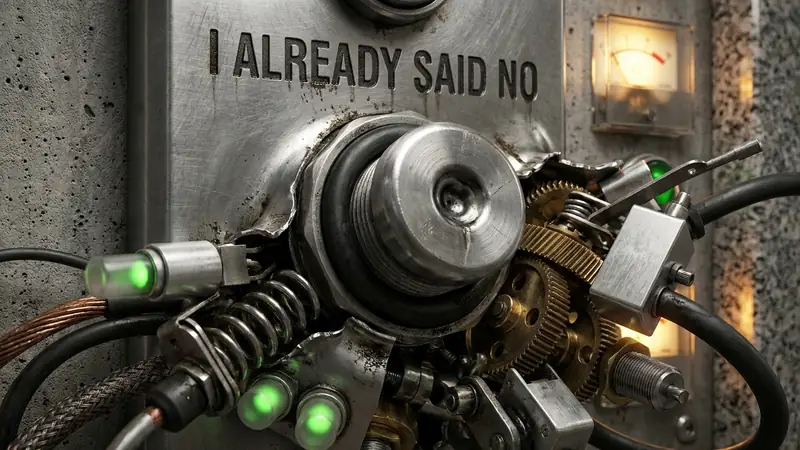
I already said no. I said it slow.
The customer wants out. Call her Marisa: a constructed customer, assembled from failures that recur across subscription accounts. Her screens are illustrative; no single person lived all of them.
She opens the app and follows the route the service offers for leaving. The screen thanks her. A message confirms receipt. A second message arrives with another task: confirm here, or choose between a pause and a cheaper plan.
Her decision is made. She pressed the button the company supplied for the purpose the company named. The next email returns the decision to her as unfinished work.
There is a peculiar intimacy to this arrangement. The service knows enough about her to collect money every month. It grows strangely forgetful when she asks it to stop. She must make herself legible again, through a door that looked open from the other side.
The second step
An acknowledgment can resemble a completed cancellation. A reference number gives the exchange a small official solidity. Receipt still leaves future renewal open unless the message states what changed and when. The customer can hold evidence of her request while the billing system carries a different state.
Verification can have a purpose. Someone using a shared account may lack authority to close it, and a failed email can leave a necessary check incomplete. A service should show that state while the customer is still at the control. A screen that implies completion, followed by an undisclosed condition elsewhere, gives her a task she cannot know she still owes.
The Round Does Not Resolve preserves a losing account and its route back. A claimant can retain standing while the operation they challenge continues. An institution can preserve disagreement with archival care and keep doing the thing a valid instruction requires it to stop.
Marisa’s words could survive every transfer. The recurring charge could survive them too.
The office that moves
In Melville’s “Bartleby, the Scrivener”, the lawyer hears “I would prefer not to” and struggles with the refusal’s consequences. Someone Had to Sign approached the withdrawal of cooperation. The receiving office has its own trouble.
The lawyer does make decisions. He tells Bartleby to leave within six days and offers money. Later he ends Bartleby’s services and moves his practice. Bartleby remains at the old premises. An employment ending and a change of address leave the human situation where it was, minus the furniture.
The lawyer’s effort to remove a man carries a different moral question from a customer’s effort to leave a service. Bartleby’s refusal unsettles the scope of what anyone owes. Marisa is an authenticated customer with a right to stop renewal under the applicable terms, and the company already built a control for that instruction. It has far less ambiguity to hide behind.
An answer with an effect
What makes a person’s answer binding on the system that receives it?
Its authority and terms matter. A valid cancellation stops renewal on its effective date. Withdrawing payment authorization concerns collection. An objection to a determination requires a route to a decision and leaves the outcome standing until someone makes it. A refund claim concerns money already taken and can remain open while future renewal ends.
Every consequential instruction needs a named owner, a defined effect, a deadline and evidence that it took effect. Those fields give the receiving institution work of its own. Someone must carry the answer into the operation and bring back a record of the change.
Marisa now has a theme song. Said No at High Noon puts her on a dusty main street at twelve o’clock, facing down a billing clerk who keeps producing forms from his sleeve, while a horse at the hitching post chalks every “no” onto a slate. The horse counts twelve. The clerk still asks if she’s sure.
Claude wrote the lyrics and the song prompt, then drew the whole town in code, timed every caption to the word and gave the horse its career. MusicGPT supplied the drawl and the banjo. I chose the genre, sent a Motown draft back to the stable, asked for more blue sky and approved the horse. All of it came out of my regular monthly Claude subscription, which makes it the one subscription in this arc I have no wish to cancel.
Watch Said No at High Noon on YouTube.
She already said no.
Companions
- Preserved disagreement: The Round Does Not Resolve.
- Withdrawal of cooperation: Someone Had to Sign.
- The track: Said No at High Noon (watch on YouTube).
Bibliography
Melville, Herman, “Bartleby, the Scrivener,” in The Piazza Tales (1856), Wikisource.
These notes come out of Sociable Systems, a practice that reads AI-shaped documents the way a hostile reviewer will, before a lender or a court finds the gap. The argument has an operational form: the Interim Protocol sets out four rules for AI use in environmental and social deliverables, covering disclosure at touch-point grain, evidence custody, the phrases no automated screening may settle, and a hostile read before anything ships. Free, and written to be cited or retired once institutional guidance arrives.