
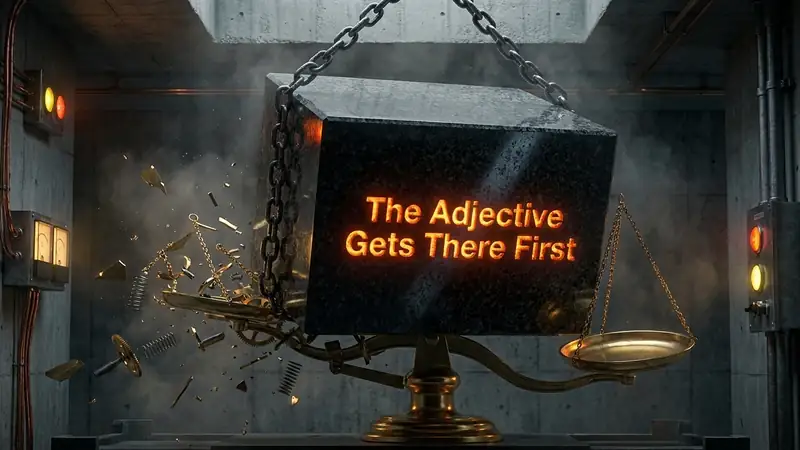
The machine can acquire a new title before it acquires a new capability. The US executive order of 29 September 2026 directs the executive branch, to the extent permitted by law, to replace “Artificial Intelligence” and “AI” with “Super Intelligence” and “SI” in official non-statutory documents. Its definition covers the technologies encompassed by the existing statutory definition of AI. The renamed category requires no new demonstration that any particular system performs better.
The order exempts previously issued instruments, including contracts and regulations, and directs preparation of proposed statutory language. The official vocabulary changes within a defined scope. The systems themselves wake up the next morning with the same properties they had the night before.
An affected person can therefore meet a formidable adjective attached to an ordinary disputed output. The name enters the room with official backing. Whether anyone grants it extra credibility is a question about the institution’s procedure, and one that deserves an answer.
D.I.
Digital Intelligence offers a plainer name. It identifies a medium and leaves capability open to examination. In Afrikaans, die AI means “the AI.” The old name survives inside the new sound, while English ears hear a darker verb. One audience gets an article; another hears a threat. Naming is sociable work, even when the thing being named is digital.
The pun decides nothing about whether a system has interests or how well it performs. It makes the audience visible. An official title written for agencies and vendors also reaches the people whose claims the system processes. They inherit a vocabulary chosen elsewhere, and then they have to argue with it.
Standing in the procedure
Marisa, from I Already Said No, contests a renewal that remains active after a valid cancellation. Her case needs records of the instruction and the billing change. Calling the platform intelligent supplies neither.
Suppose a service routes contested outputs for human review only when the system reports low confidence. That rule hands a confident error a procedural advantage: the affected person must first get into a review route that excludes the case by design. The confidence score concerns the model’s output. Her right to challenge an inconsistent charge comes from somewhere else entirely.
Marketing language could reinforce that deference. Showing that it does, in a particular institution, takes workflow records. A product name cannot tell us what a support agent believed or which team received the complaint.
The Human in the Display Case describes responsibility without power to change an outcome. A customer can face a related arrangement: evidence in hand, with no route to anyone permitted to weigh it against the system’s record. A human presence in the process offers little if the output has already acquired immunity from correction.
Deference with an override
The EU AI Act’s human-oversight provisions, Article 14, address the tendency to over-rely on output from high-risk systems. The text pairs awareness of automation bias with the ability, as appropriate and proportionate, to disregard or reverse an output. Those provisions have a defined high-risk scope, and most subscription platforms sit outside it.
The design lesson travels further. A reviewer needs authority to examine the contested record and change the outcome where the evidence requires it. Awareness training cannot substitute for permissions. A button marked human review reproduces the display case if its occupant can only explain what the system says.
The NIST AI Risk Management Framework likewise treats validity and reliability as properties requiring evidence in the context of use. A category name establishes nothing about a particular output.
Contested records
A complaint procedure should say how conflicting records are weighed and who decides the dispute. The system’s output can be relevant evidence. Its name supplies no reason to presume it correct. Capability claims belong beside the tests that support them, with their limits stated where a reviewer can use them.
For Marisa’s cancellation, the decision-maker should compare her dated instruction with the applicable terms and the renewal record. A developer may also need to investigate a defect. That investigation should run on a separate route, so that fixing the platform does not hold the individual decision hostage to the next release.
The institution should record what it decided and which operation followed. A customer needs an answer about the account, even while the engineering team still owes an answer about the code.
The adjective can stay on the letterhead. It earns no vote in her dispute.
Companions
- Responsibility without power: The Human in the Display Case.
- What voice depends on: What Voice Costs.
Bibliography
European Parliament and Council, Regulation (EU) 2024/1689 (13 June 2024), Article 14, EUR-Lex.
National Institute of Standards and Technology, Artificial Intelligence Risk Management Framework (AI RMF 1.0) (2023), section 3, AI risks and trustworthiness.
Trump, Donald J., “Inaugurating the Era of Super Intelligence” (29 September 2026), sections 2–3, executive order.
These notes come out of Sociable Systems, a practice that reads AI-shaped documents the way a hostile reviewer will, before a lender or a court finds the gap. The argument has an operational form: the Interim Protocol sets out four rules for AI use in environmental and social deliverables, covering disclosure at touch-point grain, evidence custody, the phrases no automated screening may settle, and a hostile read before anything ships. Free, and written to be cited or retired once institutional guidance arrives.