
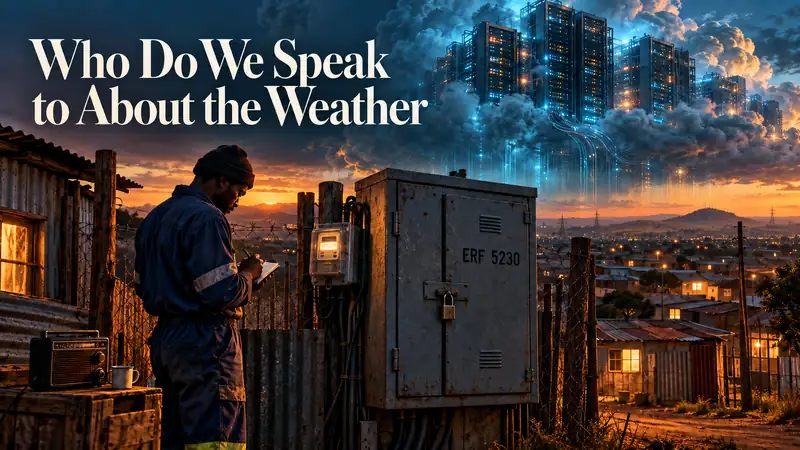
My neighbour asked me: who do we speak to about the weather? I laughed. He didn’t.
A radio forecaster opens the song in the voice every airport lounge knows. Scattered compute over the peninsula tonight. High availability from the coast. Her voice comes soaked in reverb, as if found between stations. She reads the outlook with the calm of someone who never stands in a queue. Then a guitar enters, dry and close, so close you hear the fingers on the strings. A man starts to tell us how the cloud looks from the fence line.
The Weather Has an Address borrows from maskandi, the Zulu guitar tradition of storytelling song. The picking keeps time while a voice tells the tale. Here the weather becomes something a household must reckon with. A household reckons with drought that way, or with a new neighbor big enough to set the habits of the street.
The narrator remembers the paperwork first. The paper said a warehouse. Everyone on that street knows warehouse paper, so the street stayed calm. Then came three days of trucks, and the road wore a groove where nothing heavy used to go. His neighbor asks the question of the title. The two men walk to the fence, where the household meter has a new cousin: a bigger meter, steel, with a padlock and a long number on its door. He writes the number down. That is what people do there. Something new arrives, and you learn its number first. Its name comes later, if it comes.
The forecaster cuts in with sky-language (visibility at street level: excellent; sustained availability: ninety-nine point nine nine nine). The narrator carries on at the fence. Her forecast and his account occupy the same song, waiting for an answer that joins them.
The yard learns to talk back
Who Can Call the Promise In asked who can enforce a promise when the people exposed never signed the contract. A buyer could point to an agreement. The public depended on regulators or a chance to intervene in a proceeding. The question passed to the people downstream: what happens when they stop waiting to be asked?
They have stopped. In Nova Scotia, an announcement of a data center at Point Tupper met a province-wide petition against AI data-center development. In Box Elder County, Utah, protests began within hours of a developer’s renewed application to change the use of ranch water. Two earlier applications were withdrawn after drawing thousands of protests.
In Denver, residents of Globeville and Elyria-Swansea already live beside a refinery and sites designated for federal cleanup. They objected to a data center rising near their homes. The council imposed a one-year moratorium on new ones, while the permitted building kept rising. In Cape Town, the King Air land-use approval is suspended during an appeal.
Each dispute has its own decision-maker. A petition asks a government to act; a water protest enters an allocation process. Residents can see where a facility will stand long before they know which objection can change it.
A doctor who expects thanks
Henrik Ibsen dramatized the conflict in 1882. In An Enemy of the People, a coastal town stakes its fortune on new medicinal Baths. Dr Thomas Stockmann, the Baths’ medical officer, finds the water fouled by the tanneries upstream. He expects the town to thank him. He expects the newspaper to print his report and the householders to stand behind him. By the fourth act, a public meeting votes him its enemy. By the fifth, his landlord gives notice and his daughter loses her teaching post.
The play is unkind to everyone, which makes it useful. Stockmann is right about the water and wrong about almost everything else, including how a town decides. His brother the Mayor guards the ratepayers, and the editor guards his readers. The printer Aslaksen, chairman of the householders, prizes moderation above every other civic virtue. Each man can explain himself. Add up the explanations and you get a town that would rather drink the water than pay for the pipes.
The data-center fights turn Ibsen’s town around. Here residents near proposed facilities ask about the water. Microsoft’s annual report records “hyper-local dissent” among the obstacles to its infrastructure, beside power supply and permits. A question about the place where people live becomes a risk to the company’s plans.
When the sky comes down
In the song’s closing section, the distance between the voices begins to shrink. The forecast comes down toward the guitar and the narrator’s register. He answers with a place on the ground. The cloud acquires a neighbor.
He names Erf 5230, a parcel identified in a public environmental application record for a data-center expansion at Samrand, in Centurion. It is a different site from King Air in Cape Town. An erf is a numbered parcel of land in South African property records. It gives the song a concrete place to send its imagined account. Whatever draws on the ground should be answerable there. The narrator asks for the weather to be named.
The forecaster reads the parcel back. Her closing phrase, confirmed before approval, reverses the sequence traced in Confirmed After Approval: figures needed for a decision arrive after it. Here the answer belongs before the permission.
An objection that has found its address still needs a place to be heard.
The track
The Weather Has an Address moves between a forecaster above the cloud and a narrator at the fence. Their encounter gives the approval question a voice.
Credits
Concept by Liezl Coetzee. Lyrics and song prompt drafted with GLM, music rendered in MusicGPT, stills from NotebookLM, layered scene art from Codex, and the 3D world, animation and assembly by Claude.
Companions
- Who Can Call the Promise In, on routes written before a commitment hardens.
- The Erf Number, on the parcel where land becomes an account.
- Confirmed After Approval, on figures scheduled past the decision.
- The Account Must Have an Address, on authority that can be found and asked.
- The track: The Weather Has an Address.
Bibliography
Armstrong, Lyndsay, and Devin Stevens, ‘EverWind’s $10B AI data centre draws public backlash, call for debate’, The Energy Mix and The Canadian Press, 20 October 2026.
Banta, Megan, ‘Kevin O’Leary’s Utah data center again draws protests over Great Salt Lake water’, Salt Lake Tribune, 20 October 2026.
Booth, Michael, ‘Denver names data center advisory group amid moratorium’, Colorado Sun, 7 October 2026.
Enviroworks, Draft Basic Assessment Report: Samrand Data Centre Expansion, August 2022, cover and project description.
Ibsen, Henrik, An Enemy of the People (1882), trans. R. Farquharson Sharp (Project Gutenberg).
Microsoft, ‘Form 10-K for the year ended June 30, 2026’, Item 1A, ‘We may be unable to develop and expand adequate infrastructure’.
Sociable Systems, The Weather Has an Address, music video, October 2026.