
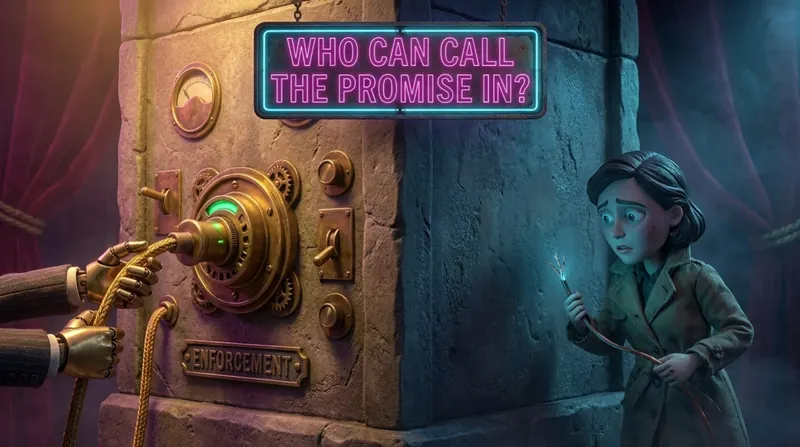
A supplier can invoice the company. A resident can write to it. The difference between those two acts sits in the obligation attached to each.
The supplier holds a contract that defines payment and a remedy for default. The resident may hold a right to comment on a permit and no claim under the supply agreement. Both live with the consequences of the same expansion. Only the supplier can enforce that payment obligation.
What the ledger holds
Six entries in, the ledger has filled in a pattern. The Future on Account began with a promise that makes other people budget around it, and with Dickens’s Bleeding Heart Yard, whose residents followed a great financier’s fortunes and had no say in them. The Number With the Missing Label showed that the most-quoted figures circulate long before anyone has signed a document a reader can test. Your Investor, Your Supplier followed a guarantee that lapses as soon as its customer earns a satisfactory credit rating. The Bill Has a Date watched the gas pipelines of the 1980s settle their unbreakable contracts at 14.6 cents on the dollar, with a regulator deciding how much of the settlement costs reached the end of the pipe. Public Money, Private Rules met two laboratories that protect their missions from shareholders while leaving the mission’s beneficiaries without a door. No Shares, Still a Bill turned up a real safeguard in Indiana, and a contracting party the public order names only as a subsidiary of Alphabet.
Set side by side, the entries sort themselves. Where the exposed party signed something, the last column has a name in it. Where the exposed party is the public, the column goes thin, or blank. The sorting rule is the one The Account Must Have an Address stated for automated determinations, generalized: what makes any promise disputable is a principal who answers for it and a route a person can use. The market’s instruments have both. The public’s routes exist, as Monrovia shows, but they are indirect and uneven: they run through intervenors and regulators, and they attach to particular approvals and rate decisions instead of to the promise itself.
| Commitment | Made by | Exposed if it fails | Who can call it in |
|---|---|---|---|
| Build capacity for demand yet to arrive | The lab, in supply agreements | Suppliers and their lenders | The named counterparties |
| An honest account of revenue and losses | The issuer, in its prospectus | Investors and the public argument | Regulators and purchasers under antifraud rules; Section 11 once effective |
| Stand behind the customer’s payments | The supplier, as guarantor | The supplier’s shareholders and the facility’s lenders | Beneficiaries, on the instrument’s triggers |
| Pay for reserved capacity, used or not | The lab | Investors, lenders, customers, ratepayers | The supplier by contract; for ratepayers, a regulator |
| Govern for a mission wider than shareholders | Founders’ vehicle and trust at one lab; nonprofit board at the other | The public named in the mission | The bodies themselves, and state attorneys general |
| Pay its own way, including on exit | An Alphabet subsidiary, unnamed in the public order | AES Indiana’s other customers | The utility and the commission; households through intervenors, with mixed results |
| Share the gains through a public fund | An institution, if one is created | Defined beneficiaries | ________ |
The last row is a proposal. It is also the row with the longest history.
The fund and the dividend
OpenAI’s April policy paper proposes, on page 7, a Public Wealth Fund investing in diversified assets, with returns that could be distributed directly to citizens. How the fund would be seeded is left to policymakers and AI companies, and the paper treats the United States as its starting point. It is a policy proposal, and no one holds a share of it yet. The closest working example is older than any AI company.
Alaska has paid its residents a dividend from oil wealth through the Permanent Fund since 1982. Its record shows what a dividend can and cannot call in. In 2016, facing a budget crisis, Governor Bill Walker vetoed roughly half the dividend, cutting it from more than $2,000 to $1,022. A state senator and two former lawmakers sued, arguing the statutory formula required the full payment. The Alaska Supreme Court unanimously upheld the veto in August 2017: the formula sat in a statute, but the transfer still needed an appropriation, and appropriations are within reach of a veto. Within the decade lawmakers had abandoned the formula as unaffordable and now set the amount in the budget each year; last year’s $1,000 check was the smallest since 2020. This October, Alaskans are receiving $1,200, a $1,000 dividend plus a $200 energy relief payment, at a cost to the state of over $800 million.
Forty-four years of dividends is a real achievement, and the check matters to the households that receive it. The lesson for anyone designing a fund around AI is what the check did not carry. Recipients had a payment and no enforceable claim to its size; when the money was needed elsewhere, the beneficiaries discovered they were a line item. A dividend also buys no vote in the oil field. It never gave a family near a pipeline any standing to contest the pipeline.
So a public wealth fund needs an account of its mandate before it needs a name. Who appoints its managers, and who can remove them? Which corporate decisions do its holdings let it influence, and can a beneficiary see how that influence is used? What happens to the distribution when the treasury is short? And what remedy, if any, does a person hold when the answer disappoints? Each of those questions fills in the blank column, or confirms that it stays blank.
The word “citizen” draws a boundary too. People outside that constituency use the same products and live beside data centers serving the same companies. A national scheme can be valuable and still leave cross-border exposure to other institutions.
Before the concrete sets
The routes in the ledger that work well tend to share one feature: they were written before the commitment hardened. The take-or-pay clause existed before the pipeline was laid. The Monrovia minimum was agreed before the substations were built. Monrovia’s rate-case rehearing shows a late route can still open; late routes cost more and reach less. The safest route for the next community is the one negotiated in advance.
When the Answer Counts closed an arc about a customer’s instruction by specifying what gives a promise effect inside an operation: a named owner, a defined effect, a deadline, evidence of completion. The Account Must Have an Address specified what makes a decision disputable: a principal who answers, a basis preserved outside the machine, authority to reconsider, a route to contest. Both lists were written for automated systems, and they carry over to the ledger. The supply agreement has a named owner and a defined effect, which is why a supplier can sue on it. The prospectus, before it takes effect, is a promise only partly open to testing. The trust is a principal whose name changes while the office persists. The tariff allocation is a decision explained in public on terms partly kept confidential. One question covers all of them, whether the machinery that receives a promise is a billing system or a capital market: what does it owe to the people who carry the consequences without having written it?
The practical demand follows. People asked to accommodate a buildout need the terms before approval, and time to challenge how costs are shared. They need an authority able to impose conditions, and evidence later that the conditions held. None of this is hostile to building useful AI. Glass laid in the telecom bubble still carries traffic, long after many of the companies that laid it went under. The case for a public account rests on the people who carry part of the cost without having signed for any of it.
When Mr Merdle’s complaint was finally diagnosed, Dickens sent the ruin into “innumerable homes” that had never been shown the books. Nobody in this ledger is Merdle. The Yard is still there, though, without a seat at the board’s table.
The future can be shared. The invoice needs an address.
Companions
- When the Answer Counts, on giving a valid instruction effect.
- The Account Must Have an Address, on answerable authority.
- The track: Put It on Tomorrow.
Bibliography
Alaska Supreme Court, Wielechowski v. State, S-16558, 25 August 2017.
Alaska’s News Source, ‘Permanent Fund dividends will be distributed to Alaskans starting this week’, 30 September 2026.
Anchorage Daily News, ‘Alaska Supreme Court upholds Gov. Walker’s 2016 veto of half of Permanent Fund dividend’, 25 August 2017.
Bohrer, Becky, ‘Alaskans get money every year from the state’s oil wealth fund. But the latest dividend check is the smallest since 2000’, Associated Press via Fortune, 28 September 2025.
Dickens, Charles, Little Dorrit (London: Bradbury and Evans, 1857), Book the Second, chapters 13 and 25.
OpenAI, ‘Industrial Policy for the Intelligence Age: Ideas to Keep People First’, April 2026, p. 7.