
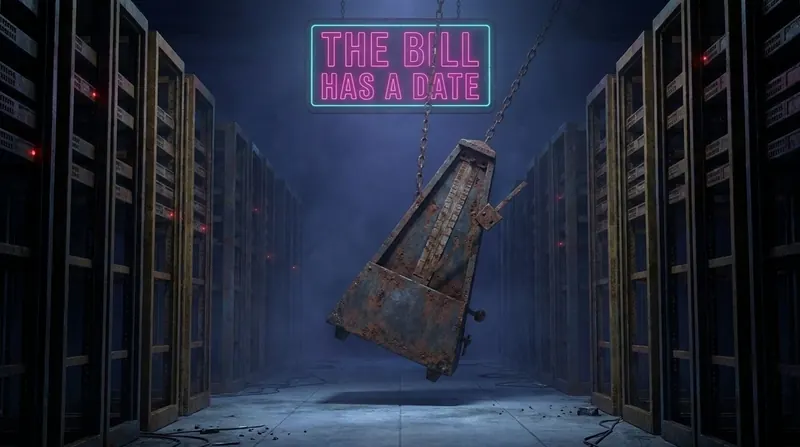
The industries that build pipelines and mines have a blunt name for one of their oldest arrangements: take-or-pay. The buyer agrees to take a minimum volume, or pay for it anyway. The seller, who has borrowed heavily to build something that cannot be moved, gets a revenue floor its lenders can believe in. It is one of the more honest instruments in commercial life, because it says out loud who carries the risk of being wrong about demand. The trouble begins when someone is very wrong at scale.
A young AI company can now find itself on the buyer’s side of that bargain. When its customers reduce their use and the capacity bill keeps arriving, the interval between those two events can matter more than the size of its latest funding round.
Doors of different widths
Reuters’s September 29 review of Anthropic’s confidential prospectus shows how varied the doors out of such commitments can be. The agreements with Google and Amazon carry minimum spending commitments payable even if usage falls short. The Microsoft obligation is largely non-cancelable, except for an uncured material breach. An agreement for capacity from xAI, by contrast, is largely cancelable on ninety days’ notice, which in this market counts as a revolving door. The headline total of $518 billion hides all of that under one number.
Anthropic is paying up to $84.5 billion through 2029 for Nvidia-based capacity from a rival laboratory, leased from the company that makes Grok. Both laboratories are short the same scarce input, and the practical explanation is arithmetic: when demand outruns every available fab, a rival with spare capacity is a supplier first and a competitor second. It also leaves Anthropic’s widest exit running through a rival of its two largest backers.
The width of the door changes the meaning of an idle machine. Under usage pricing, a quiet month lowers the bill. Under a minimum commitment, the buyer pays for capacity it leaves dark, and its customers (who mostly pay by use and can leave at short notice) take none of that risk with them when they go. Imagine a laboratory whose clients trim their consumption over a single quarter while its own minimum payments run for years. It can hunt for new customers or renegotiate with its supplier, and neither remedy reliably arrives before the invoice does.
A profitable unit of service can therefore coexist with a company short of cash. The price of each answer covers the cost of producing it; the reservation sitting unused behind it still needs paying for. Margins per query make a cheerful chart. The reservation is what keeps the finance director up at night.
The pipeline precedent
This has been done before, in an industry that also believed it was building the future and was right about most of it.
In the 1970s, with gas apparently scarce, American interstate pipelines promised producers to take, or pay for, 80 percent or more of their gas at high regulated prices for ten years or longer. As a federal appeals court later summarized the bargain, “The buyer bears the risk of market demand.” Demand duly fell in the 1980s (recession, cheaper alternative fuels, new supply and some unhelpful weather all played a part), and the pipelines found themselves obliged to buy far more gas than they could sell. By 1986 their exposure stood at about $10.7 billion. Most of them then did something the contracts did not contemplate: they declined to perform, and invited the producers to sue. What followed was a negotiation, and then a regulation.
The Federal Energy Regulatory Commission’s Order 500, in 1987, let pipelines recover between a quarter and half of their take-or-pay costs through a fixed charge if they absorbed an equal share themselves, with more recoverable through a surcharge on gas sold. FERC’s reasoning was that no single segment of the industry was wholly to blame, so every segment should carry some of the burden (DeCanio’s 1990 analysis found evidence that the order raised spot prices for end users). By 1989, according to figures FERC compiled, more than $44 billion of take-or-pay claims had been settled at 14.6 cents on the dollar.
A non-cancelable contract met by a collapse in demand tended, in practice, to end in a settlement, and settlements are where the bargaining power shows. Once the private contracts failed, it was a public regulator that decided how much of the settlement costs would land on customers at the end of the pipe, people who had signed nothing.
Built on borrowing
The pipelines rehearsed their crisis forty years ago. A live version is now under way, and the supplier is Oracle, which sells OpenAI the compute behind a contract reported at about $300 billion. Oracle built ahead of demand the way pipelines build ahead of gas, and it paid for the build the way pipelines paid: by borrowing. A downgrade in July left its credit rating one notch above junk, and its 2055 bonds have traded near 77 cents on the dollar, against capital spending guided at up to $95 billion for the fiscal year, when analysts had expected about $68 billion.
On October 8 the cost of insuring Oracle’s debt against default closed at a record 261 basis points, Bloomberg reported. The appetite for that insurance had been building for a while: as early as December 2025 the Financial Times reported, from clearing-house data, that the market for default protection on debt tied to the AI buildout had grown 90 percent since the previous September. Behind the headline numbers sits a quieter version of the same strain. The $18 billion of loans financing Oracle’s New Mexico campus, known as Project Jupiter, were quoted privately at 89 to 91 cents on the dollar by the syndicate banks trying to sell them, which have kept more of the debt on their own balance sheets than planned (Reuters, reporting the Financial Times). A below-par quote mixes doubt about demand with interest rates, construction risk and liquidity. What it does establish is that professional buyers wanted a discount before holding paper whose repayment depends on the campus’s business.
The ledger connection runs through concentration rather than through any single contract. The reported OpenAI contract alone would account for close to half of Oracle’s $664 billion order backlog, and that customer is a company that still loses money on operations and depends on financings Oracle does not control. When a supplier borrows to serve a customer, take-or-pay risk does not disappear; the supplier’s lenders also become exposed, and in the past fortnight they repriced that exposure. The premium moved. The payments promised underneath it stayed put.
Deadlines outlive debts
Countdown clocks have a habit of outliving the debts they count down to. SpaceX, now the listed parent of xAI and X, arranged a $20 billion bridge facility in March to refinance debt associated with those businesses. Its June 2026 quarterly filing records that the bridge was repaid in June from the proceeds of new notes. Reports from the spring that treat the bridge as a looming cliff are describing a loan that no longer exists. The financing requirement moved to different creditors on different terms, and the new schedule is the one to read. A refinancing changes who holds the claim; it rarely makes the claim go away.
An IPO is another source of money for the same purpose, which is why the timing of a listing matters to people who will never buy a share. A supplier’s contractual payment date and an executive’s preferred market window are both dates. Only one of them can be enforced.
Pressure on the price
A company with minimum payments to meet has strong reasons to keep its reserved capacity busy. Lower prices fill machines and thin margins. Higher prices protect margins and empty machines. Either way, the choice is shaped by an obligation negotiated well before the customer arrived.
Customers who have rebuilt their work around a service inherit those choices. Some can switch providers; others have rebuilt their processes and retrained their staff around one model, and would face real costs to leave. A financing agreement made in another room can narrow their options without anyone intending harm, and without a scandal to point at.
It is tempting to go further and read safety decisions or product withdrawals as the hidden hand of the capacity bill. Financial pressure identifies an incentive to investigate. It cannot, by itself, supply anyone’s motive, and the record of a particular decision is the only thing that can.
Who carries the cost
Every party to these arrangements can allocate risk deliberately. A supplier may grant cancellation rights in exchange for a higher price, while a buyer may accept a minimum to secure scarce capacity. A lender may demand a guarantee before advancing funds. A utility may require a large customer to post collateral before it builds. Each places uncertainty with someone who expects to be paid for carrying it, which is how a market should work.
The difficulty lies with the people who are paid nothing for carrying it. When infrastructure depends on public utility investment, a separate agreement must specify who pays if the expected load fails to arrive, and the gas pipelines are a reminder of what happens when nobody wrote that clause in advance.
Ledger, entry four. Commitment: pay for reserved capacity whether or not it is used. Made by: the lab, in its supply agreements. Exposed if it fails: the lab’s investors and the supplier’s lenders first, the lab’s customers through prices, and utility ratepayers wherever a public grid was built for the load. Who can call it in: the supplier, under the contract; for ratepayers, the regulator, in advance where a large-load agreement exists and after the fact where none does.
The pipelines learned the price of second thoughts in the 1980s, and part of the bill went to people at the end of the pipe.
Bibliography
Axios, ‘Oracle rekindles the data center debt risks’, 25 September 2026.
Babu, Juby, and Stephen Nellis, ‘Oracle’s AI spending blows past estimates, raising worries over growing debt’, Reuters, 10 June 2026.
DeCanio, Stephen J., ‘Cross-Contract Crediting under FERC Order 500’, Contemporary Economic Policy, 8.2 (1990), 159–175.
Financial Times, ‘Investors seek protection from risk of AI debt bust’, 15 December 2025.
Looper, Scott, ‘Take-or-Pay Crisis v2.0: What Wind Power Generators and Providers Failed to Learn from Gas Pipelines’ 1980 Dilemma’, Houston Journal of International Law, 33.2 (2011), 303ff.
Mutua, Caleb, Preeti Singh and Laura Benitez, ‘La deuda para financiar la IA golpea al crédito tecnológico en medio de una reevaluación del riesgo’, Bloomberg Línea, 8 October 2026.
Oil & Gas Journal, ‘Settlements reduce take-or-pay exposure’.
Oracle, ‘Oracle Announces Q1 Results’, September 2026.
Reuters, ‘Oracle’s $18 billion data center debt under pressure, FT reports’, 18 September 2026.
Space Exploration Technologies Corp., ‘Form 10-Q for the quarter ended June 30, 2026’, ‘Debt’, ‘SpaceX Bridge Loan’.
Wang, Echo, and Sabrina Valle, ‘Anthropic’s $518 billion AI buildout hinges largely on deals that cannot be canceled, filing shows’, Reuters, 29 September 2026.