
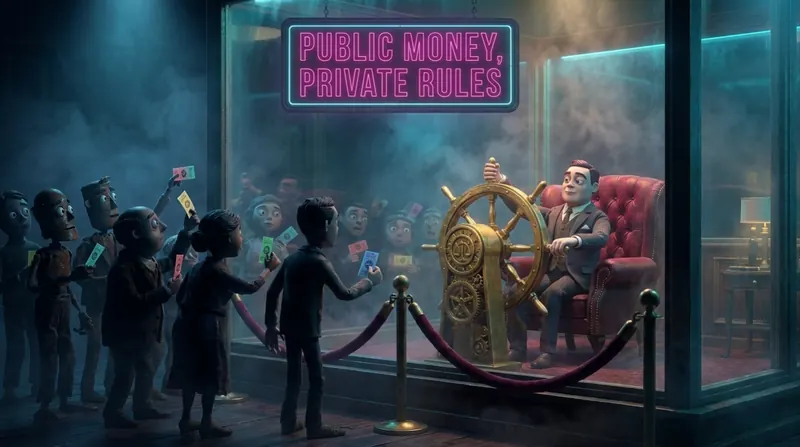
A public company can accept your money while reserving its decisive votes for someone else. The invitation to own and the authority to govern arrive on different pages of the same document, and only one of them gets the large print.
The modern high-water mark belongs to Snap, which in March 2017 sold the public shares carrying no votes. The index providers, briefly, were scandalized. S&P Dow Jones Indices announced that July that companies with multiple share classes would no longer be eligible for new inclusion in the S&P 500 and its sister indices. Six years later, after consultation, it reversed the rule. The reversal received a fraction of the attention, and it matters more than the scandal did, because index membership decides what passive funds buy automatically, and eligibility is the gate to membership. If a company with unequal votes enters an index a pension fund tracks, savers in that fund acquire a sliver of it without anyone having asked them, on whatever voting terms the share structure allows.
The SEC also asks investors to examine voting rights when they read an offering. The fraction of a company you own and the fraction of its power you can exercise are separate numbers. The difference becomes interesting when a business promises benefits to people far beyond its shareholders.
Two locks, two keys
Anthropic’s proposed arrangement is more intricate than the phrase “founder control” allows. Reuters’s review of its confidential prospectus describes a Founder LLC, initially made up of the seven co-founders, a majority of whom would direct a Class F share holding 50.1 percent of the voting power on specified corporate matters. Separately, the Long-Term Benefit Trust would elect four of the board’s seven directors, with Class F and Class A holders electing the other three. These are terms reported from a draft, and drafts change before they meet the market.
The design has two locks, and the keys belong to different people. A summary that says the founders control the board erases the trust; a summary that says public buyers can acquire ordinary control erases the special share. The stated purpose of both is to protect the mission from investors who would trade long-term caution for a better quarter, and that is a real danger in a company whose most consequential decisions (when to release, when to hold back) are the ones a market tends to punish.
Insulation, though, works in both directions. A board protected from a shareholder majority is also protected from everyone else, unless someone builds a door.
What the door is made of
The trust now has three members: Neil Buddy Shah and Richard Fontaine, joined in July by Ben Bernanke. A fourth, Mariano-Florentino Cuéllar, stepped down in August to join the company as its first Chief Global Affairs Officer, so the door between overseer and executive has already swung once. The FT’s September 4 report, citing people familiar with the trust, adds that shareholders need 85 percent of the voting power to remove a trustee, that trustees receive advance notice of major actions including new model launches, and that trustees meet weekly among themselves and with leadership as often as every other week. The trustees are credited with encouraging the limited rollout of a cybersecurity model, Glasswing, through a sponsored program, which is the closest thing reported so far to the trust visibly moving anything.
Critics have pressed on the design rather than the personnel. The trust’s architects themselves (Morley, Simmerman and Berger, writing by invitation on the Harvard corporate-governance forum) confirm that the trust agreement leaves its amendment to a stockholder supermajority, with enforcement open to large holders as well as trustees, and Zach Stein-Perlman’s criticism sharpened that admission into the central question: if the shareholders can amend the arrangement, what can the trust do against their interests? Anthropic has not published the trust agreement, so the amendment threshold remains a number no outsider has seen (the FT’s 85 percent concerns removal, a separate action). The more pointed complaint concerns publication itself: the paper stays private in a company asking the public to buy its shares on the strength of the mechanism.
The founding trustees with direct AI-safety backgrounds have since left: the company’s own updated account records departures by choice, with reasons, from December 2023 through January 2026. Ewan Kingston, commenting in August, pressed on the trust’s board-appointment power and on the absence of direct alignment expertise among its members, questions a prospectus should answer before the public buys in.
When a laboratory appoints a former central bank chair and a national-security policy veteran to the body meant to answer for the fate of its models, it ties that body to established policy institutions. Whether the ties serve public benefit or reputational underwriting will show in the trust’s decisions; the unpublished agreement would at least disclose its powers and limits.
The nonprofit in the room
OpenAI has a different arrangement and a different paper trail. The Delaware attorney general’s account of its October 2025 recapitalization records that the nonprofit keeps sole authority to appoint the directors of the public benefit corporation and the power to remove them, along with safety oversight powers that extend to requiring mitigations and halting model releases. Those commitments were secured through the attorney general’s review, which gives them an enforcer of sorts. How they will be expressed in an eventual prospectus remains to be seen.
That gives an inquiry a more exact address than the popular shorthand in which one chief executive simply owns the place. A chief executive’s influence and a nonprofit board’s formal authority are different facts, and the useful question is whether the board will exercise its powers on the day doing so costs the business money. The existence of a power to halt a release establishes a mechanism. Its worth will be measured in releases halted, or in the reasons recorded for not halting them. There is one precedent for the board using its sharpest power. In November 2023 the nonprofit board removed its chief executive; within five days OpenAI announced an agreement for his return, and its later announcement named a new initial board of Bret Taylor, Larry Summers and Adam D’Angelo, the one director from the removal vote who stayed. The structure has since been rebuilt, with an attorney general’s review behind it, and no comparable public confrontation under the revised structure has come to light.
A mission to benefit humanity gives the organization an ample purpose. It does not hand any member of humanity a vote, or a right to compel a particular decision. The two laboratories have reached for different structures, and both justify insulated control by the mission while leaving the mission’s beneficiaries without a defined way to call it in.
The listing that already landed
SpaceX supplies a completed transaction to set beside the proposals. Its June 2026 quarterly filing confirms that it issued new Class A shares in its offering, and that Class A carries one vote per share against ten for Class B. Public money and unequal votes coexist without much fuss; they have for decades.
The issuer’s perimeter matters as much as its votes. The listed group now includes xAI and the X platform alongside the rockets and satellites, with Grok and X reported inside an AI segment that also holds AI infrastructure. A shareholder buys exposure to that whole consolidated issuer. A person affected by one of its data centers needs something narrower: the entity that owns the facility, and the regulator with authority over it. The ticker supplies an address for ownership. The obligation to the neighbors may be registered somewhere else entirely.
The public in public ownership
“Public” does two jobs in this vocabulary, and they rarely meet. The first public can buy shares, directly or through a fund, and acquires a vote that the share structure may render decorative and that, in any case, the fund usually casts on its behalf. The second public cannot or does not invest, and its interest in the company runs through the grid and the planning office. Selling shares to the first group does nothing for the second.
Dickens’s Bleeding Heart Yard belonged firmly to the second public. Its residents talked of Merdle constantly (the lodger was said to be saving up for one of his enterprises) and had no say in what he did. The modern versions are better organized, with trusts and nonprofit boards and published commitments, and that is real progress. The test of whether it amounts to accountability is whether a person outside the share register can bring evidence to one of those bodies and see an operation change as a result.
Ledger, entry five. Commitment: govern for a mission broader than the shareholders. Made by: the founders’ vehicle and the trust at one lab, the nonprofit board at the other. Exposed if it fails: the public named in the mission, which is everyone, which in practice means nobody in particular. Who can call it in: the trust and board themselves; for OpenAI, the Delaware attorney general on the commitments that office secured, with California also recorded as involved in the review. For a member of the public, the column is blank.
Bleeding Heart Yard read about Mr Merdle in the morning papers, which was as close to a vote as it ever got.
Bibliography
Anthropic, ‘Ben Bernanke appointed to Anthropic’s Long-Term Benefit Trust’, 9 July 2026.
Anthropic, ‘Mariano-Florentino (Tino) Cuéllar to join Anthropic as Chief Global Affairs Officer’, 4 August 2026.
Anthropic, ‘The Long-Term Benefit Trust’, 19 September 2023, with later notes on trustee changes.
Davis Polk & Wardwell, ‘Snap decision: Leading index providers nix multi-class shares’, 2017.
Delaware Department of Justice, ‘AG Jennings completes review of OpenAI recapitalization’, 28 October 2025.
Dickens, Charles, Little Dorrit (London: Bradbury and Evans, 1857), Book the Second, chapter 13.
Kingston, Ewan, comments on LessWrong, August 2026.
Morley, John, Amy Simmerman and David Berger, ‘Anthropic Long-Term Benefit Trust’, Harvard Law School Forum on Corporate Governance, 28 October 2023. The authors participated in designing the trust; the account is the architects’ explanation of the structure.
Murgia, Madhumita, ‘Anthropic’s $2tn IPO puts trustees in spotlight’, Financial Times, 4 September 2026; republished by Ars Technica.
OpenAI, ‘Sam Altman returns as CEO, OpenAI has a new initial board’, November 2023.
Reuters, ‘Anthropic leaders to control AI lab via “Founder LLC” to promote public good over market forces’, 28 September 2026, updated 29 September 2026.
Simpson Thacher & Bartlett, ‘S&P Dow Jones reverses course on index eligibility for multiple share class structures’, 19 April 2023.
Space Exploration Technologies Corp., ‘Form 10-Q for the quarter ended June 30, 2026’, ‘Initial Public Offering’ and ‘Voting Rights’.
Stein-Perlman, Zach, ‘Maybe Anthropic’s Long-Term Benefit Trust is powerless’, LessWrong, 27 May 2024.
US Securities and Exchange Commission, ‘Updated Investor Bulletin: Investing in an IPO’, 14 October 2022.
Wikipedia, ‘Removal of Sam Altman from OpenAI’, accessed 16 October 2026.