
Abraham Lincoln runs out of paper. In the story Neal Stephenson tells, the boy puts a shovel in the fire and waits for it to cool, then scratches his lessons through the soot. When the surface fills, he heats it clean and starts again. A reusable notebook with an inconvenient charging arrangement.
Stephenson reaches for the shovel in his conversation with Ashlee Vance on Core Memory. Vance has just described a 22-year-old building a nuclear fusor in his bedroom with Claude as his guide, moving between speech and diagrams as the apparatus takes shape. Stephenson’s reply is that the young man would probably have done well a century earlier too. Some people find their way through difficult conditions, soot and all.
That is true, and it is also a survivor’s story. The shovel tells us about the boy who made it to the White House. It says nothing about the children who never found a shovel, or found one and had nobody to tell them which lessons to scratch on it. Stephenson’s own worry, a few minutes later in the same conversation, runs the other way: a device that reaches mainly people who already have plenty of support may widen the distance between them and everyone else.
The commission
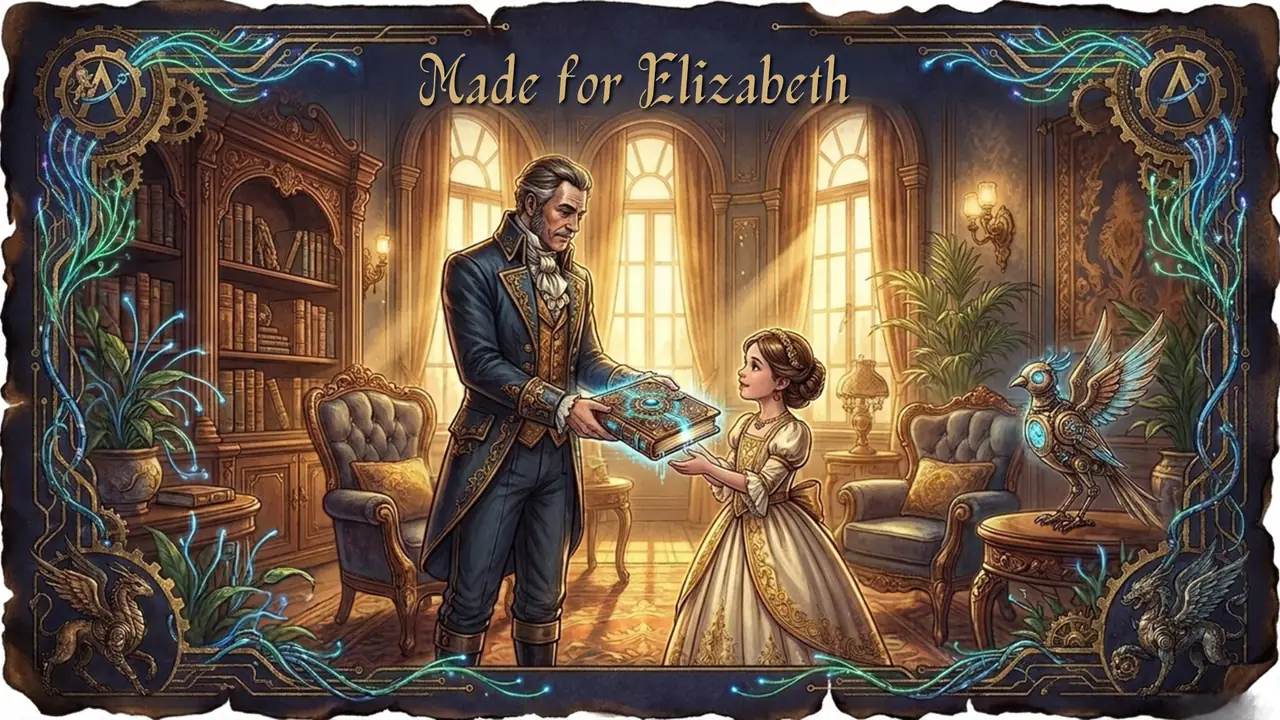
The Diamond Age opens that worry with a purchase order. Lord Alexander Chung-Sik Finkle-McGraw, an Equity Lord of the neo-Victorian enclave New Atlantis, has noticed that his class raises children who are well-behaved and dull. He wants his granddaughter Elizabeth to become something more interesting, and he can afford to pay for it. He commissions an engineer, John Percival Hackworth, to build her a book.
The Primer is made for Elizabeth. Every design choice serves a child who already has a governess and a family that expects her to rule something someday. The book’s job is to add an edge of subversion to an otherwise complete upbringing. It is a luxury good in the precise sense: an improvement for someone whose basics are already handled.
Hackworth, who is not an aristocrat, wants the same thing for his daughter Fiona. He makes an unauthorized copy. On his way home, a gang of boys robs him, and the book ends up in the hands of Nell, a girl living in a household where nobody reads to her and several adults are a danger to her.
Three children reach the same book by routes their families would never think to compare.
Tiers
Today’s Primers are sold without the mugging, mostly. Their makers offer a free tier with limits and a paid tier with more of everything, from a larger model to the patience to keep going when the conversation runs long. Enterprise contracts sit above that, with their own privacy terms and support staff. The structure is ordinary software pricing, and it maps onto Stephenson’s three children with uncomfortable neatness.
The Elizabeth tier belongs to people whose employers or parents pay for the best model and who already know what to ask it. The Fiona tier belongs to people who get there through ingenuity: a shared account, a student discount, a workaround. The Nell tier is whatever reaches someone with no plan and no money, which in practice is the free version on a secondhand phone with data that runs out on the twentieth of the month.
The free version is often very good. That deserves saying plainly, because a child in a crowded classroom with a patient explainer in her pocket has something no previous generation of poor children had. The gap sits elsewhere: in the hours of use the data allows, in whether anyone nearby can help her ask better questions, and in whether the book still works when her account changes or her country falls on the wrong side of an export rule.
The thing the shovel cannot measure
Vance’s fusor builder is an Elizabeth story told in a bedroom. He had the space and the confidence to start, and the assistant made the work more fluid. What the anecdote cannot tell us is whether the same assistant, handed to someone without the bedroom or the confidence, would help her begin. Fluency with a tool may shorten the distance between ambition and competence. It can also disguise how long that distance is, which matters when the project involves high voltage and vacuum pumps.
Stephenson’s Primer handles this through story. Nell does not receive lessons as verdicts on whether she belongs in a classroom. She receives a princess in trouble who needs to learn something to get out of it, and the learning arrives because the story needs it. Difficulty becomes part of an adventure. That is a design choice, and it was designed for Elizabeth. Nell benefits from it by accident.
The present question is whether anyone is designing for Nell on purpose. Pricing decides much of that before a single lesson begins. So does who sits nearby when the explanation stops making sense.
The shovel still works. It just doesn’t answer back.
Companions
- Primer in Your Pocket
- Primer in Your Pocket, the track.
Bibliography
Stephenson, Neal. The Diamond Age, or, A Young Lady’s Illustrated Primer. New York: Bantam Spectra, 1995.
Vance, Ashlee. Interview with Neal Stephenson. Core Memory. Interview passages at 1:29:25–1:32:27.