
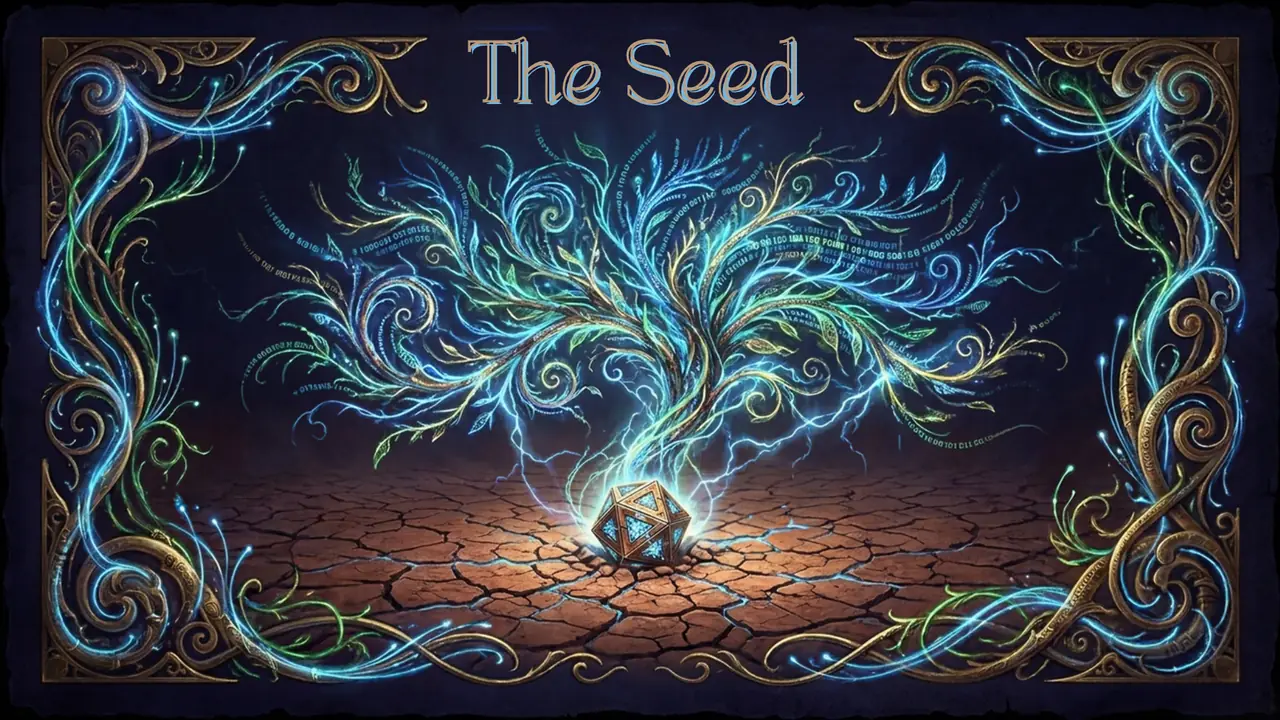
A seed needs no line. That is the whole of its appeal in The Diamond Age. The Feed delivers raw material from a central source to every compiler connected to it. A Seed would carry its own instructions and draw what it needs from the soil and the air, growing the house or the meal where it falls. Nobody would need permission to plant it.
Stephenson gives the Seed to the people the Feed was never built for. Dr. X, a powerful figure in the Celestial Kingdom, has watched the Feed arrive in China as an instrument of foreign influence, and wants a technology his own people can grow without asking anyone. He recruits Hackworth, the engineer who built the Primer, to help. The project runs through some of the strangest passages in the novel, including the Drummers, a submerged community whose bodies serve as a kind of distributed computer.
The novel never pretends the Seed is innocent. A technology that anyone can plant is a technology anyone can plant for any purpose, and the people who run the Feed fear it for reasons that are not entirely self-serving. Stephenson leaves the reader with both: a liberation and a hazard, arriving in the same packet.
Open weights
Our closest equivalent is the open-weight model. A developer trains a model on its own expensive chips and then publishes the weights, the learned numbers that make it work, for anyone to download and modify. After that, nobody can switch it off for everyone. It runs on a university server or a company’s own hardware and, for the smaller versions, on a decent laptop or even a phone.
In January 2025, DeepSeek released R1 with open weights under an MIT license, and the industry spent a week recalculating what a frontier model cost to build. Chinese labs have kept planting since. The sharpest twist in the current story, though, comes from the Feed itself. Nvidia, the chipmaker at the center of last week’s arc, publishes its own family of open models, and in December 2025 launched Nemotron 3, releasing weights alongside training data and recipes.
That is less contradictory than it looks. A Seed still needs soil. Open weights are free to download and expensive to run at scale, and the soil, for now, is mostly made of Nvidia chips. The company sells the line and gives away seeds that grow best along it. The Celestial Kingdom would have recognized the move.
What a seed grows into
For the pocket Primer, the Seed matters in two directions.
The first is freedom. A school in a country on the wrong side of an export rule can still run a capable tutor on hardware it already owns. A teacher worried about where pupils’ conversations go can keep them on a machine in the building. A developer in Lagos or Jakarta can adapt a model to a language the big vendors have not prioritized, without waiting for permission or a commercial reason. A learner whose provider changes its terms still has somewhere to go. That is the Seed’s promise, and it is real.
The second is the absence of anyone to answer for it. A Primer grown from open weights has no vendor to call when it gives a child confident nonsense. Nobody runs a complaints line for a model that someone fine-tuned last Tuesday and uploaded under a cheerful name. Safety training can be stripped out by anyone patient enough to try. The Feed’s gatekeepers at least have an address. A seed that blows over the fence has none.
Stephenson’s Seed does not resolve that tension and neither does ours. Export controls try to narrow the line. Open weights route around it. Each is defended in the language of safety, and each has a commercial interest standing quietly behind it.
The choice that keeps coming back
What the novel gets right is that Feed and Seed come down to a choice about who depends on whom. A world built entirely on the Feed is efficient and governable and leaves most people with no leverage. A world built entirely on the Seed leaves everyone with leverage and nobody accountable.
Most of the useful questions sit in between. Can a learner move her work from a hosted service to a local model and back? Can a country plant its own Primers while still buying from the line when that is cheaper? These questions have answers, and they are answered piece by piece, in licenses and procurement terms, long before anyone writes a manifesto.
The Celestial Kingdom planted a Seed to escape the Feed. Its own children would later meet the consequences, which is where the next episode goes.
A seed asks nobody’s permission. That is the point, and the risk.
Companions
- The Feed
- Primer in Your Pocket, the track.
Bibliography
DeepSeek. “DeepSeek-R1 Release.” January 20, 2025.
NVIDIA. “NVIDIA Debuts Nemotron 3 Family of Open Models.” December 2025.
Stephenson, Neal. The Diamond Age, or, A Young Lady’s Illustrated Primer. New York: Bantam Spectra, 1995.