
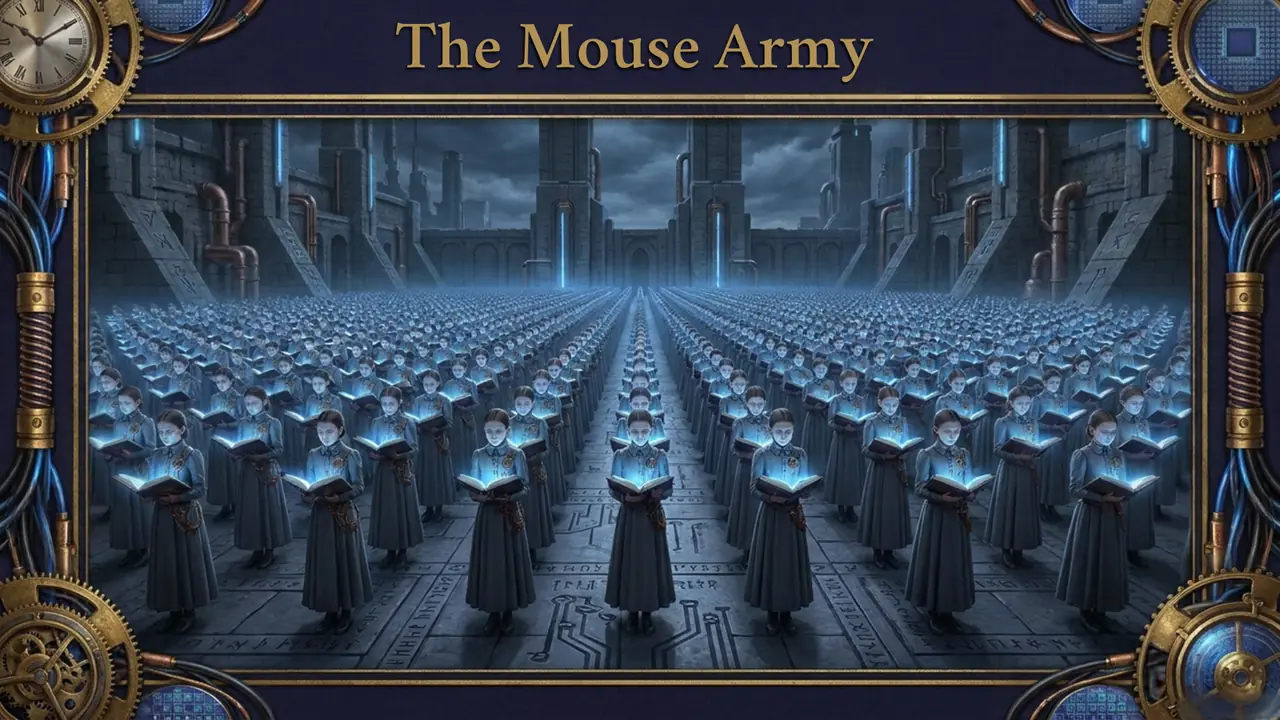
Late in The Diamond Age, the Primer goes into mass production. Dr. X, who has acquired the design along with Hackworth’s obligations, orders copies for the abandoned baby girls of the Celestial Kingdom, by the hundreds of thousands. Each girl receives her own book, and each book raises her.
It is one of the most generous acts in the novel and one of the most unsettling. These are children nobody else was going to educate. The Primer teaches them to read and to fight their way out of its stories. They grow up capable. They also grow up together, shaped by the same book from the same supplier, and when they finally appear in the plot they move as one: a disciplined, devoted army of young women who call themselves, with some affection, the Mouse Army.
The difference between them and Nell is Miranda. Nell’s copy had a performer on the other end who came to know her as a particular child. The mass copies did not. They were good books. Nobody inside them was paying attention to any one girl.
Primers by the hundred thousand
On January 26, England’s Department for Education announced that up to 450,000 disadvantaged pupils a year could benefit from AI tutoring tools, aimed at pupils in years 9 to 11 eligible for free school meals. The department says the tools will be co-created with teachers and tested in schools, with versions available by the end of 2027. A separate call invited AI labs and edtech companies to build them, with a commitment that pupils’ work will not be used to train AI systems without parental permission.
The intention is admirable and the target group is the right one. Tutoring in England fell away after the National Tutoring Programme ended in 2024, and the children who lost it were the ones whose families could not pay to replace it. A patient explainer that works at ten at night, for a child whose parents work nights, is a serious offer. Stephenson would recognize the generosity. He would also recognize the number.
The evidence is thin, and the government has said so. Researchers quoted by Schools Week describe the research on AI tutoring as being in its infancy. The same coverage notes that the department has not made clear how much human teachers and tutors will be involved. That question is the whole of Miranda’s chapter.
Same book, many children
Mass provision does something that individual provision cannot. It makes a single supplier’s choices part of a generation’s upbringing. Which explanations count as clear, and which tone a struggling child hears when she gets it wrong for the fourth time: those are design decisions, and at national scale they are curriculum.
The Mouse Army is Stephenson’s picture of what that looks like when it works. The girls are loyal and astonishingly competent. What they lack is variety. They learned from one source in one voice, with nobody inside the book to notice that one of them was different and needed a different story.
England’s plan contains the obvious answer: teachers. If the tools are co-designed with them and used alongside them, the Miranda role has somewhere to live. The risk sits in the budget. A tool bought partly to reduce workload can easily become a reason to stretch each adult across more children, and then the book is doing the attending by default.
What a buyer at this scale can ask for
A government ordering Primers in bulk has more leverage than any parent. It can ask questions a single family never could.
It can ask which supplier’s Feed the tool runs on, and what happens to the service if that supplier’s prices or export status change. It can require that a pupil’s work, and the record of what the tool told her, leave with her when she changes school. It can insist on more than one supplier, so that a generation is not raised in a single voice. And it can fund the human time to watch how each child is doing, which no contract specification can produce on its own.
That is ordinary procurement. Stephenson’s Dr. X did not need any of it, because he answered to nobody and the girls had no one else. A democratic government ordering books for other people’s children has rather different obligations.
The Mouse Army turned out loyal. The interesting question is to whom.
Companions
- The Seed
- Someone in the Pages, on Miranda and the people inside today’s Primers.
Bibliography
Department for Education. “450,000 Disadvantaged Pupils Could Benefit from AI Tutoring Tools.” GOV.UK, January 26, 2026.
Department for Education. “EdTech and AI Companies Invited to Help Build Safe AI Tutoring Tools for Disadvantaged Pupils.” GOV.UK, 2026.
Schools Week. “DfE’s AI Tutoring Plan Prompts Calls for More Research.” 2026.
Stephenson, Neal. The Diamond Age, or, A Young Lady’s Illustrated Primer. New York: Bantam Spectra, 1995.